
Official Baltimore County Warrant Sources
Warrants in Baltimore County start with the courts. A judge or judicial officer issues a warrant after a charging document or a finding of probable cause. The Baltimore County Sheriff's Office then handles service and execution of many court-issued warrants. The Sheriff also serves court process and supports courthouse security in Towson. So the Sheriff is the law-enforcement office most tied to warrant work, even though the court issues the order. You can read about that role on the official Sheriff's Office warrants page.
Here is the key fact most people miss. There is no public Baltimore County active-warrant roster. No official county or statewide site lets you browse open warrants by name and pull a clean list. Official sources publish the Sheriff's warrant function and contact process, not an open searchable list with names, charges, and bond amounts. That means a true Baltimore County warrant search relies on the court docket, the Sheriff's Office, and the issuing court. It does not rely on one button.
Avoid third-party warrant databases. They are not official, they are often wrong or out of date, and Baltimore County does not feed them a verified live warrant list. Use the Sheriff's Office and Maryland Case Search instead.
Below is how the official routes line up. Each row points to a real method, not a public roster.
| Search or Inquiry Field | Type | Available | Notes |
|---|---|---|---|
| Public county warrant search | None found | No | No official searchable active-warrant list was located for Baltimore County. |
| Case Search by name or case | Portal | Conditional | The public docket may show a warrant or failure-to-appear entry when the case is not sealed. |
| Sheriff's warrant inquiry | Office contact | Conditional | Use the official Sheriff's Office contact channels for warrant questions. |
Types of Baltimore County Warrants
Not every warrant is the same. The type tells you who asked for it, why it exists, and how you clear it. In Baltimore County, as across Maryland, a few common kinds come up most often. Knowing the type helps you read a docket entry and helps your lawyer act fast.
- Arrest warrant issued after a charging document or a judicial finding of probable cause that names a person for arrest.
- Bench warrant issued by a judge, often after a failure to appear, a violation of a court order, or contempt.
- Search warrant that lets police search a place, person, or property, and is often sealed before it is carried out.
- Fugitive warrant used for out-of-state or other-jurisdiction custody issues when a person is wanted elsewhere.
- Violation warrant tied to a probation, pretrial, or release-condition violation.
A bench warrant is the one many people meet first. Miss a court date in District Court or Circuit Court, and a judge can order one. The fix is usually a recall or quash order, which the court enters once the issue is resolved. Search warrants work very differently and stay out of public view until they are executed.
How to Check a Warrant Through Maryland Case Search
Since there is no open county roster, the most useful public tool is Maryland Judiciary Case Search. It is the free statewide portal for many Circuit Court and District Court records. A warrant or failure-to-appear entry can show on the public docket when the case is not sealed. You will not see a sealed search warrant there. You may see a bench warrant tied to an open criminal or traffic case.
Run the lookup in a few clear steps. Use the case number from any notice when you have it, because name searches on common names pull many people.
- Open Maryland Judiciary Case Search and accept the terms and disclaimer.
- Choose the search method, usually person name or case number.
- Filter the county to Baltimore County, and remember it is separate from Baltimore City.
- Run the search and review the result rows for case number, court, party name, case type, and status.
- Open the case detail and read the docket entries for any warrant, bench warrant, or failure-to-appear line.
- Contact the issuing Clerk to confirm warrant status and to ask about certified copies.
The Case Search FAQ explains that not all case data is public and that some entries are delayed. For broader help with court files, the Maryland Judiciary also keeps a court records help page. Case Search is a docket index, not the full file. The Clerk holds the certified documents.
Baltimore County Warrant Search Fields
When you use Case Search to look for a warrant entry, you fill the same public fields used for any case lookup. There is no separate warrant-only form on an official county site. The table shows the main public fields and how each one helps narrow a Baltimore County warrant search.
| Field Label | Type | Required | Notes |
|---|---|---|---|
| Search Type | Tab / dropdown | Yes | Person name, business name, or case number; exact labels vary by interface. |
| Last Name | Text | Conditional | Required for a person-name search; spelling matters, so use fewer terms to broaden. |
| First Name | Text | No | Narrows a person-name search. |
| Case Number | Text | Conditional | Used for direct case lookup; enter the full case number as shown on a notice. |
| Court System | Dropdown | No | Circuit Court or District Court where available. |
| County | Dropdown | No | Select Baltimore County to localize results. |
For warrant questions a name search cannot answer, the official inquiry path is the Sheriff's Office, not a public list. The next section explains how to read a warrant entry once you find one.
Our Baltimore County Sheriff's Office page describes the office that serves warrants for the county. We pulled the screenshot below from that official source.
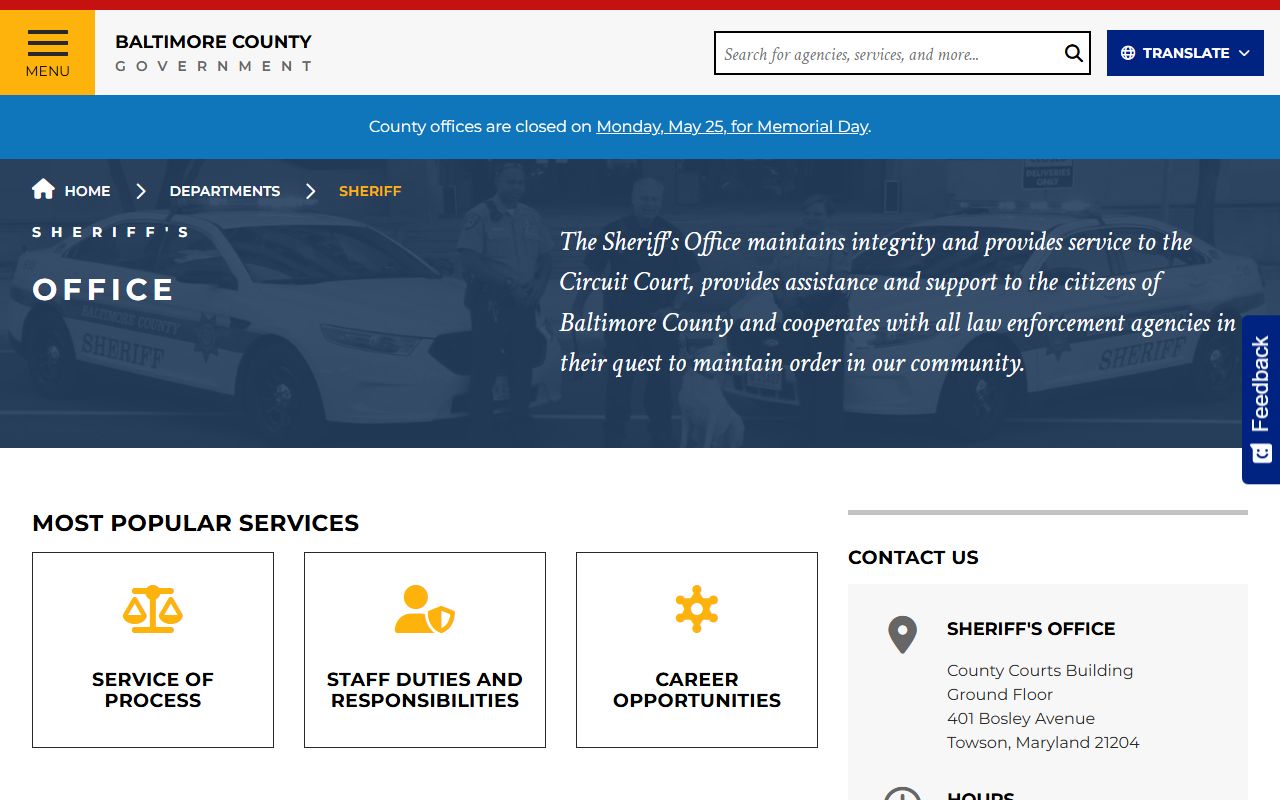
The page confirms the Sheriff's role in serving court-issued warrants, which is why warrant questions route there rather than to an open online roster.
What a Baltimore County Warrant Record Shows
If a warrant entry is public in Case Search, it appears as part of the case docket, not as a standalone warrant file. The fields below are what you can expect to read for a warrant that is not sealed. A sealed search warrant will not show these details before it is carried out.
| Field | What It Shows |
|---|---|
| Case Number | The court case the warrant is attached to. |
| Defendant Name | The named person on the case and warrant. |
| Issuing Court | Circuit Court for Baltimore County or a District Court location. |
| Warrant / Bench Warrant Entry | The docket line noting the warrant or failure-to-appear order. |
| Issue Date | The date the court issued the warrant. |
| Recall / Quash Date | The date the warrant was withdrawn, if it has been resolved. |
| Related Charge | The charge or case behind the warrant. |
| Bond / Release Info | Bond or release terms when that data is public. |
Some fields stay hidden. Sealed warrant details are not visible before execution. Juvenile, mental-health, and other protected entries do not show as normal public results either. So a clean docket does not always mean no warrant exists.
Note: A warrant entry on Case Search reflects the court docket and may lag real events, so confirm current status with the issuing court before you act on it.
How to Resolve a Baltimore County Warrant
An open warrant does not go away on its own. Ignoring it makes things worse, since a person can be picked up at a traffic stop, at work, or at home. The good news is that warrants get cleared every day through a steady, sane process. The steps below follow the official path used in Baltimore County and across Maryland.
- Do not ignore the warrant.
- Contact a criminal defense attorney, or the Maryland Office of the Public Defender if you are eligible.
- Contact the issuing court or Clerk to confirm the case number and warrant status.
- If surrender is required, coordinate it with counsel and the court or law enforcement.
- Be ready for a bail review or initial appearance.
- After the matter is resolved, confirm that Case Search updates and keep certified copies of any recall or quash order.
The Maryland Office of the Public Defender is the office that provides defense counsel for people who qualify, shown in the screenshot below.

Apply early, because the Public Defender can act on a warrant, bail review, and hearing dates that move fast. The State's Attorney prosecutes the case on the other side; you can read about that office on the Baltimore County State's Attorney page.
Important: Talk to a lawyer before you turn yourself in on a Baltimore County warrant, because counsel can arrange surrender and prepare your bail argument in advance.
Bond and Bail Review After a Warrant
When a warrant leads to custody, the next step is usually a bail review. Maryland criminal procedure requires prompt judicial review for arrested people. A judicial officer decides release terms based on the charge and risk. That decision is where bond enters the picture.
Release can take several forms. A judge may grant release on personal recognizance, set an unsecured bond, set a secured bond, order pretrial supervision, or hold someone without bond on certain charges. Bond is security for release while the case moves forward. A surety is a person or company that guarantees that bond. These terms often appear in the public docket once they are set.
- Personal recognizance means release on a promise to return with no money posted.
- Unsecured bond sets an amount owed only if the person fails to appear.
- Secured bond requires money or a surety before release.
- Pretrial supervision adds check-ins or conditions during release.
Having counsel at the bail review matters. A defense attorney can argue for lower bond or supervised release, which can be the difference between waiting in custody and waiting at home.
When Baltimore County Warrants Are Sealed
Some warrants never show in any public source, and that is by design. A search warrant is the clearest example. It is often sealed before it is executed so the subject cannot hide evidence or flee. After execution, related court entries may become accessible, but the warrant itself can stay restricted.
Other warrant entries are restricted by law or rule. Juvenile matters are confidential. Records that have been expunged or shielded will not appear as normal public results on Case Search. So a name search that returns nothing is not proof that no warrant exists; it may simply be sealed or not yet public.
Federal warrants sit in a separate system entirely. Those tie to the U.S. District Court for the District of Maryland and federal agencies, not the county Sheriff or Maryland Case Search. For federal matters, the federal court and PACER are the right channels.
Note: A blank or clean public result can still hide a sealed warrant, so treat the absence of a record as inconclusive rather than as the final answer.
The Public Defender Option in Baltimore County
People worried about cost should know that counsel may be free if they qualify. Indigent defense in Maryland runs through the Office of the Public Defender. A person seeking appointed counsel generally must apply and meet eligibility rules. Once appointed, the Public Defender acts as a full defense attorney, not as court staff.
Apply promptly after arrest or charging. Bail review, the preliminary hearing, trial dates, and plea deadlines can all move quickly, and a warrant adds time pressure. Beyond the Public Defender, several Maryland resources can help with related civil and record issues.
- Maryland Office of the Public Defender
- Criminal defense for eligible clients, including help with warrant and bail matters.
- Maryland Legal Aid
- Civil legal assistance for qualifying residents.
- Maryland Volunteer Lawyers Service
- Pro bono civil help and expungement clinics.
- Maryland Courts Help Centers
- Self-help support for civil, family, and landlord-tenant issues, with more on the self-help site.
If a warrant has already led to booking, the next step is often custody and a court date in Towson. Use the related records below to track the case and the person.