
Orphans' Court and Register of Wills
Baltimore County probate is split between two offices that work side by side. The Register of Wills takes filings, keeps estate records, issues letters to personal representatives, and runs the day-to-day estate process. The Orphans' Court is the probate court. It rules on contested estate matters and decides certain estate questions. Both sit in Towson at the County Courts Building. Maryland does not call this a "probate court" by name. The correct names are the Orphans' Court and the Register of Wills, and that matters when you search or file.
Probate covers what happens to a person's estate after death. That means the will, the assets, the debts, the claims of creditors, and the final split of property. The Register of Wills for Baltimore County handles the paperwork and public estate file. The Register of Wills for Baltimore County page is the starting point for office details and links. Appeals from the Orphans' Court follow Maryland probate appeal rules, and more complex estate disputes can reach the Circuit Court.
One warning matters most here. Baltimore County is not Baltimore City. They are two separate jurisdictions with separate Registers and separate estate files. In Estate Search the county dropdown lists both "Baltimore" and "Baltimore City" as different choices. Pick the wrong one and the estate you want will not show.
Baltimore County Probate Terms Defined
Probate filings use words that trip up most people. A short guide helps before you open an estate file or read a docket. These terms show up across Baltimore County probate records and on Maryland estate forms.
- Testator
- The person who made the will. The estate of a testator is handled with that will as the guide.
- Executor
- The person named in a will to carry it out. In Maryland this role is most often called the personal representative.
- Personal representative
- The person appointed to settle the estate, with or without a will. They collect assets, pay debts and claims, and distribute what is left.
- Intestate
- Dying without a valid will. State law then sets who inherits and in what share.
- Letters of administration
- The court document that proves a personal representative has legal power to act for the estate.
- Interested persons
- Heirs, named beneficiaries, and others with a legal stake in the estate who must get required notice.
Baltimore County Estate Search Portal
Estate files are searchable through the Maryland Register of Wills' statewide tool. Open the Estate Search portal and you can look up an estate by name, by estate number, or by county. The tool has two tabs, one for estates and one for claims. To keep results local, set the county dropdown to Baltimore. The data is current to within a day, and the page shows a "Latest data as of" timestamp so you know how fresh the file is.
A look at the live Estate Search form shows the full set of fields you can use. The lead-in image below links to the official portal so you can confirm the layout for yourself.
The Maryland Register of Wills runs the Estate Search tool that serves Baltimore County probate records.
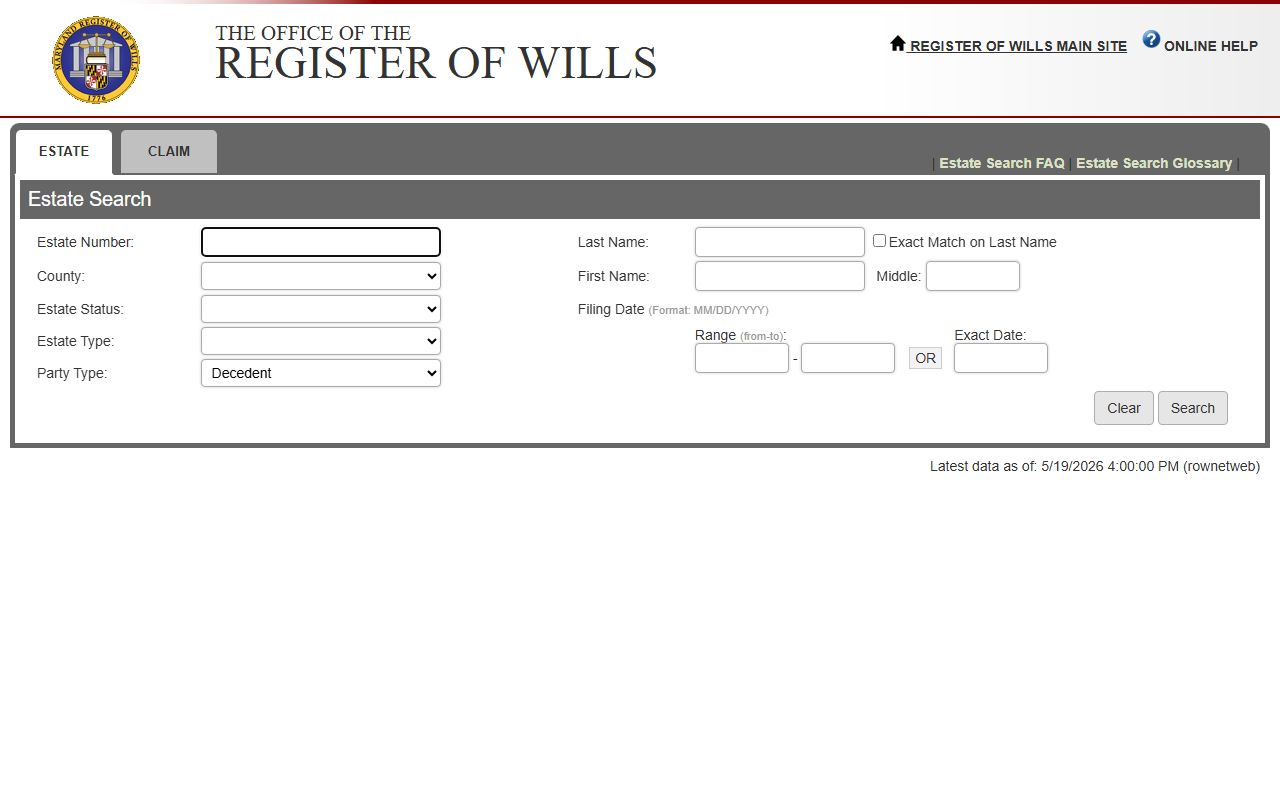
The screen sets the county to Baltimore and lets you add a last name, an estate number, or a filing date range. The table below lists every search field on the form so you can plan a search before you open it.
| Field Label | Type | Required | Options / Format Notes |
|---|---|---|---|
| Estate / Claim tab | Tab buttons | Yes | ESTATE; CLAIM. |
| Estate Number | Text | Optional | Maxlength 50. |
| Last Name | Text | Optional | Maxlength 50. |
| Exact Match on Last Name | Checkbox | Optional | Narrows surname search. |
| County | Dropdown | Optional | Blank, Allegany, Anne Arundel, Baltimore, Baltimore City, Calvert, Caroline, Carroll, Cecil, Charles, Dorchester, Frederick, Garrett, Harford, Howard, Kent, Montgomery, Prince George's, Queen Anne's, Somerset, St. Mary's, Talbot, Washington, Wicomico, Worcester. |
| First Name | Text | Optional | Maxlength 50. |
| Middle | Text | Optional | Maxlength 50. |
| Estate Status | Dropdown | Optional | Blank, ARCHIV, CLOSED (includes ARCHIVED), OPEN, PENDIN. |
| Estate Type | Dropdown | Optional | Blank, FP, LO, MA, MV, NP, RE, RJ, SE, SJ, UN. |
| Filing Date Range | Date fields | Optional | MM/DD/YYYY from-to. |
| Filing Exact Date | Date field | Optional | MM/DD/YYYY. |
| Party Type | Dropdown | Optional | Decedent; Personal Representative. |
| Clear | Button | No | Clears the search. |
| Search | Submit button | Yes | Runs the search. |
Claims are tracked separately. The Register also runs a Claim Search for debts filed against an estate. The Claim Search tool works much like Estate Search but focuses on creditor claims.
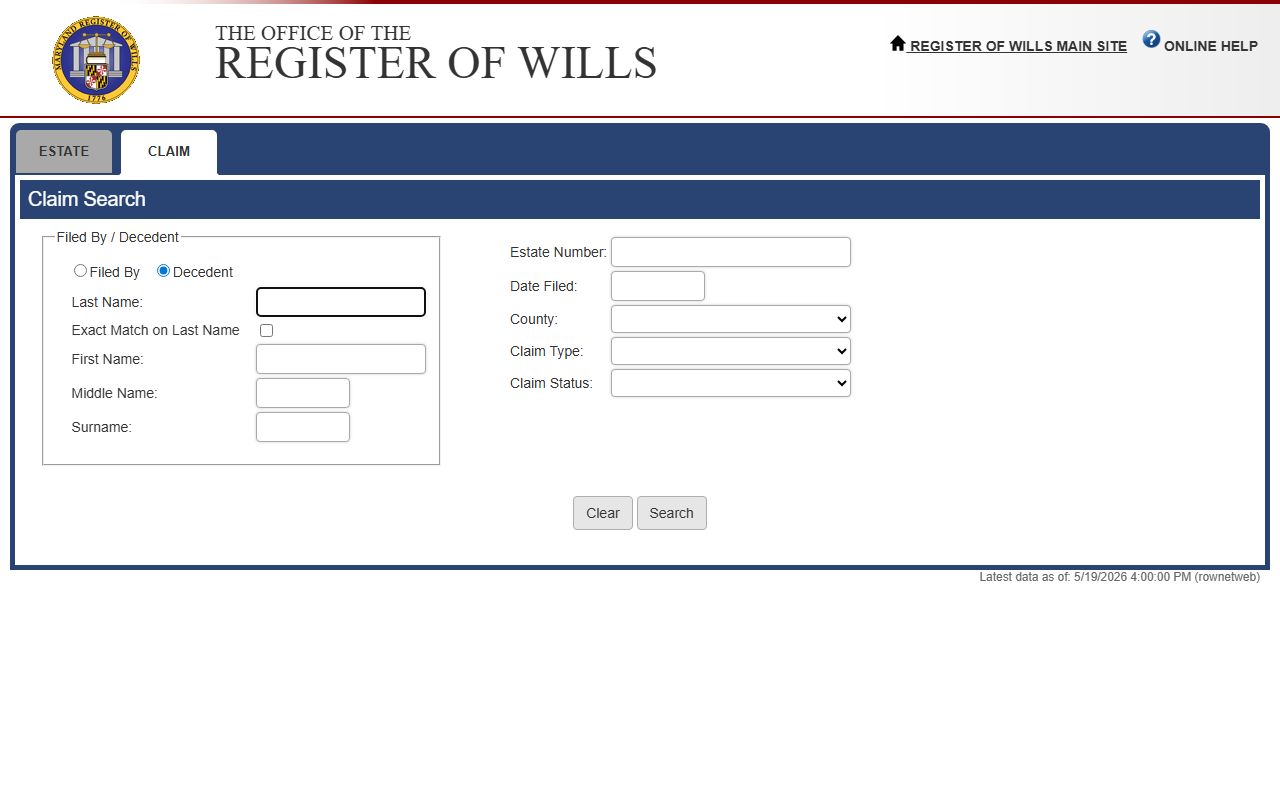
Use Claim Search when you need to confirm whether a creditor has put in a claim against an estate. It pulls from the same statewide system that holds Baltimore County estate data.
Note: Estate Search lists Baltimore and Baltimore City as two separate county choices, so confirm you picked Baltimore for county estates.
Estate Type and Status Codes
Estate Search uses short codes for the type and status of an estate. They look cryptic at first, but they tell you a lot. The status dropdown shows whether an estate is OPEN, CLOSED, PENDIN (pending), or ARCHIV (archived). The type dropdown uses two-letter codes such as SE and RE that flag small estate versus regular estate and related categories. When a name search returns many hits, status and type help you spot the right file fast.
Set the status filter to narrow a long result list. An OPEN estate is still being settled. A CLOSED estate has finished, and ARCHIV points to older files moved into archive. The full type list runs FP, LO, MA, MV, NP, RE, RJ, SE, SJ, and UN. The two that matter most to ordinary searches are SE for small estate and RE for regular estate.
Note: Code meanings can shift over time, so verify any code against the Register's own materials before relying on it for a legal filing.
Small vs Regular Estates
Maryland splits estates into small estates and regular estates based on value. The small estate track is shorter and uses fewer filings, which is why it carries its own SE code in Estate Search. A regular estate runs the full process with more notice, more reporting, and a longer timeline. The threshold that decides which track applies is set by Maryland law and can change, so confirm the current figure before you file.
A small estate still needs a petition, the will if one exists, and a personal representative. The difference is scope. There is less to inventory, fewer accounts to file, and a faster path to closing. A regular estate involves a formal inventory, an information report, creditor notice, and one or more accounts before the estate can close. Either way the file lands in the same Baltimore County estate record and shows up in the same search.
To check which type an estate used, look at the type code in the search result. SE flags a small estate. RE flags a regular estate. If you are unsure which track fits a new estate, the Register's staff and the published guidance can point you to the right form set.
How to Search Baltimore County Probate Records
The fastest path to a Baltimore County estate file is the statewide Estate Search. Set the county, add a name or estate number, then refine with status and type. The steps below walk through a clean search.
- Open the Estate Search portal and stay on the ESTATE tab.
- Set the County dropdown to Baltimore, not Baltimore City.
- Enter the last name, or the estate number if you have it.
- Add a first name or filing date range to narrow a common surname.
- Set Estate Status or Estate Type if you know it, such as OPEN or SE.
- Choose Party Type for a decedent search or a personal representative search.
- Click Search, then open the matching estate to view its record and docket activity.
If a name search returns nothing, check the spelling and try a partial last name. Older files may sit in archive status, so leave the date range open or set the status to ARCHIV.
Personal Representatives
The personal representative is the person the court puts in charge of an estate. With a will, this is usually the executor the will names. Without a will, Maryland law sets an order of priority for who can serve. Once appointed, the representative receives letters that prove their authority. Banks, title companies, and other offices ask to see those letters before they release estate assets.
The representative has real duties. They collect and protect assets, give notice to interested persons and creditors, file an inventory and information report, handle claims, and file accounts. They are accountable to the Register of Wills and, in contested matters, to the Orphans' Court. You can search an estate by personal representative by setting Party Type to Personal Representative in Estate Search.
Probate Forms
Maryland publishes the estate forms used across all counties, including Baltimore County. They cover opening an estate, the inventory, the information report, accounts, and the closing paperwork. Using the right form for the estate type, small or regular, saves a return trip to Towson.
The Register of Wills forms library lists the current statewide forms by category.
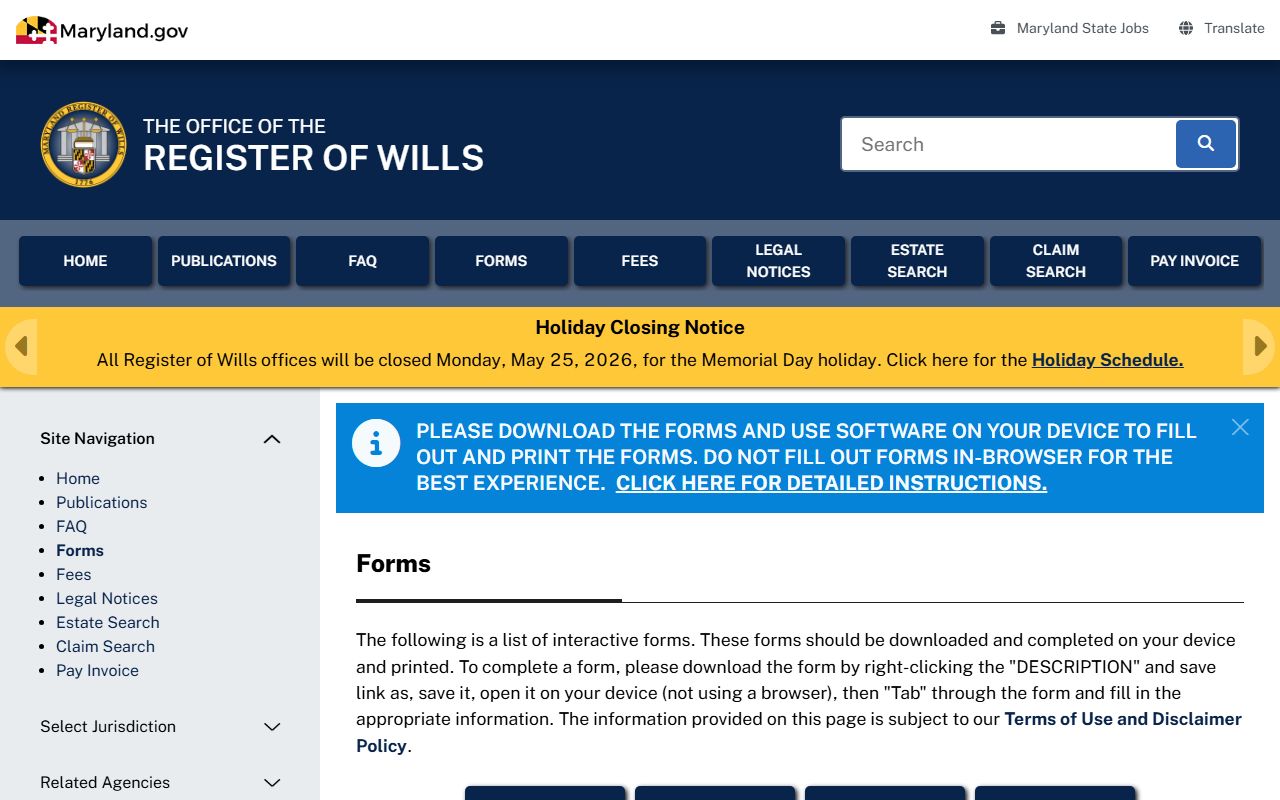
Download the forms that match your estate track before you visit the office. The Register's staff can confirm which forms a Baltimore County estate needs, but they cannot give legal advice.
Probate Fees
The Register of Wills charges fees for opening an estate, for copies, and for other estate services. Maryland publishes a statewide Register of Wills fee schedule that applies to Baltimore County. Many estate fees are tied to the value of the estate, so the exact cost depends on the file. Always confirm the current figure on the official page before you pay.
The full Register of Wills fee schedule lists probate charges and copy costs.
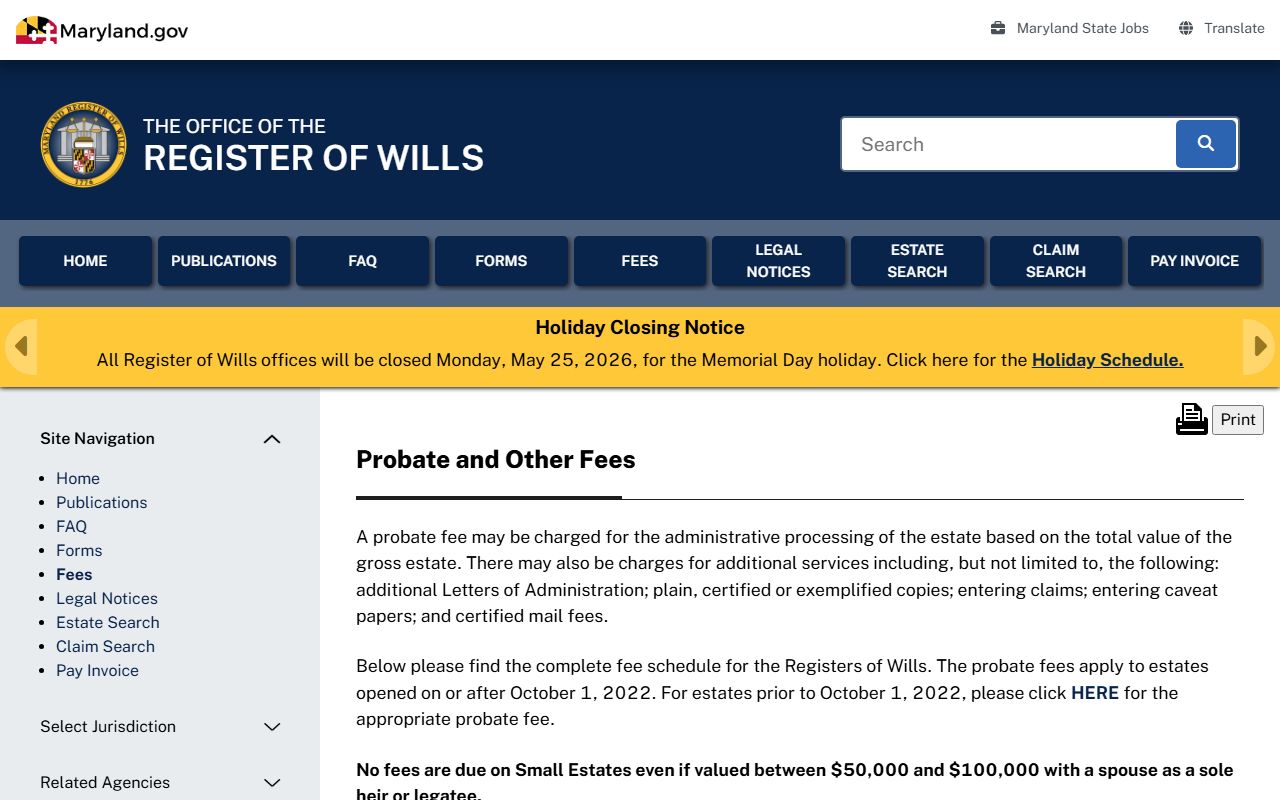
Check the fee page for the current probate cost tied to your estate's value, plus per-copy and certification charges. Court copies and certified copies carry separate fees, and certified copies are the ones accepted for legal use.
Claims and Closing an Estate
Creditors can file claims against an estate during the estate process. The personal representative reviews each claim, pays valid ones from estate assets, and disputes claims that should not be paid. Claims are tracked on the separate Claim Search and become part of the estate record. Notice to creditors and interested persons is a required step, not an option.
Closing comes at the end. The representative files the final account, the required approvals are made, and the remaining property is distributed to the heirs or beneficiaries. After approval, the estate status moves toward closed. The steps below show the full path an estate follows from opening to closing.
- Determine whether the decedent was domiciled in Baltimore County.
- Locate any original will.
- File the will and opening documents with the Register of Wills.
- Determine small estate versus regular estate using Maryland thresholds.
- The personal representative is appointed and receives letters.
- Interested persons and creditors receive required notices.
- The inventory and information report are filed.
- Claims are filed and handled through the estate process.
- Accounts are filed and approved.
- Distribution and closing occur after required approvals.
Common questions about the search tool come up often. The Register publishes an Estate Search help page that answers them.
The Estate Search FAQ explains how the statewide tool handles names, codes, and county filters.
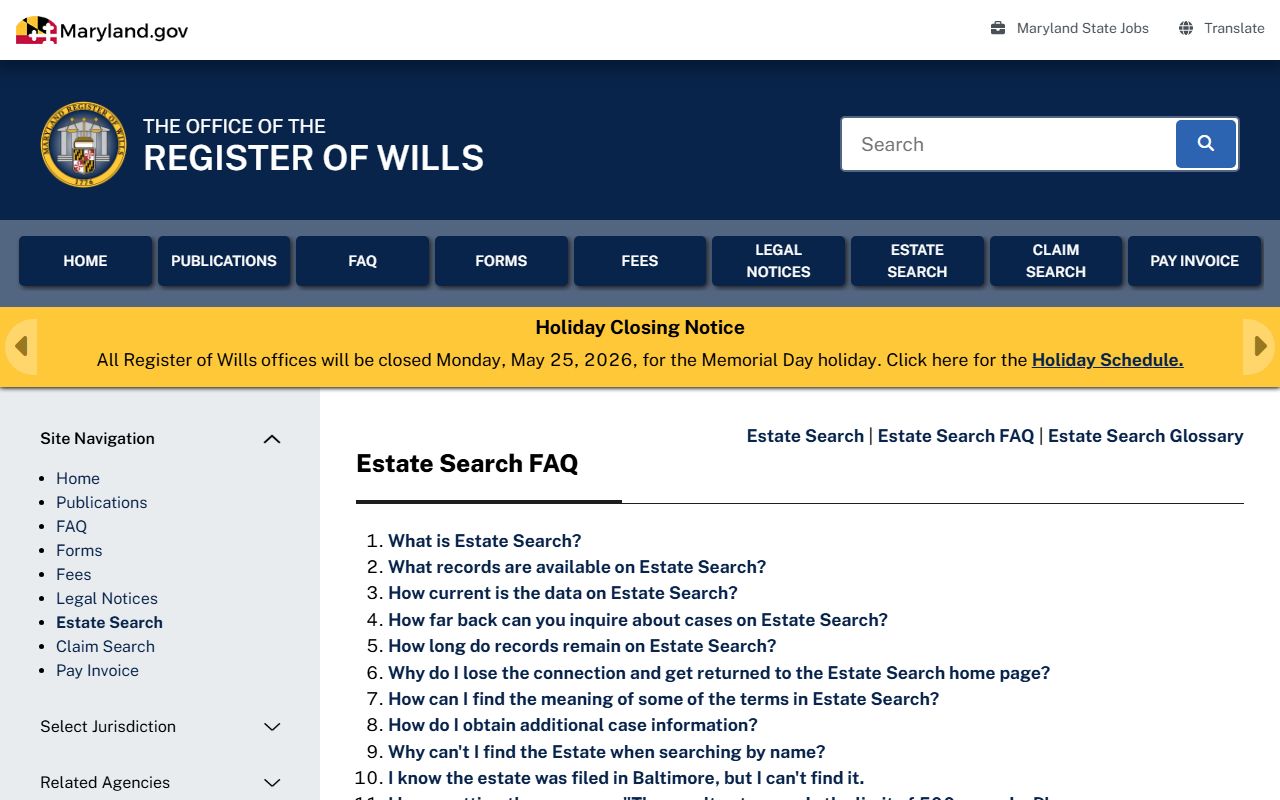
Read the FAQ if a search returns odd results or no results at all. It clears up most issues without a call to the office.
What Baltimore County Probate Records Show
An estate file holds the paper trail of a settled estate. Typical documents include petitions, the will, the list of interested persons, letters of administration, inventories, information reports, accountings, creditor claims, and the court's orders. A search result gives you the core fields that identify and track the estate.
| Field | What It Shows |
|---|---|
| Estate number | The unique file number for the estate. |
| County | The Register that holds the estate, such as Baltimore. |
| Estate status | Open, closed, pending, or archived. |
| Estate type code | Small estate, regular estate, or related category. |
| Decedent name | The person whose estate is being settled. |
| Personal representative name | Shown when searched by party type. |
| Filing date | When the estate or document was filed. |
| Docket / register activity | The list of filings and actions in the estate. |
| Claims tab | Creditor claims tracked separately. |
| Latest data timestamp | How current the displayed data is. |
The public view leaves out sensitive data. Estate Search does not show full Social Security numbers or full financial account numbers in the ordinary public display.
Register of Wills and Orphans' Court Contact
The Register of Wills and the Orphans' Court for Baltimore County share the County Courts Building in Towson. Estate files are filed, searched, and maintained at this office. The contact card below has the address and a link to the official Register page.
Register of Wills / Orphans' Court, Baltimore County
County Courts Building
401 Bosley Avenue
Towson, MD 21204
For office details and the latest hours, use the official Register of Wills for Baltimore County page.
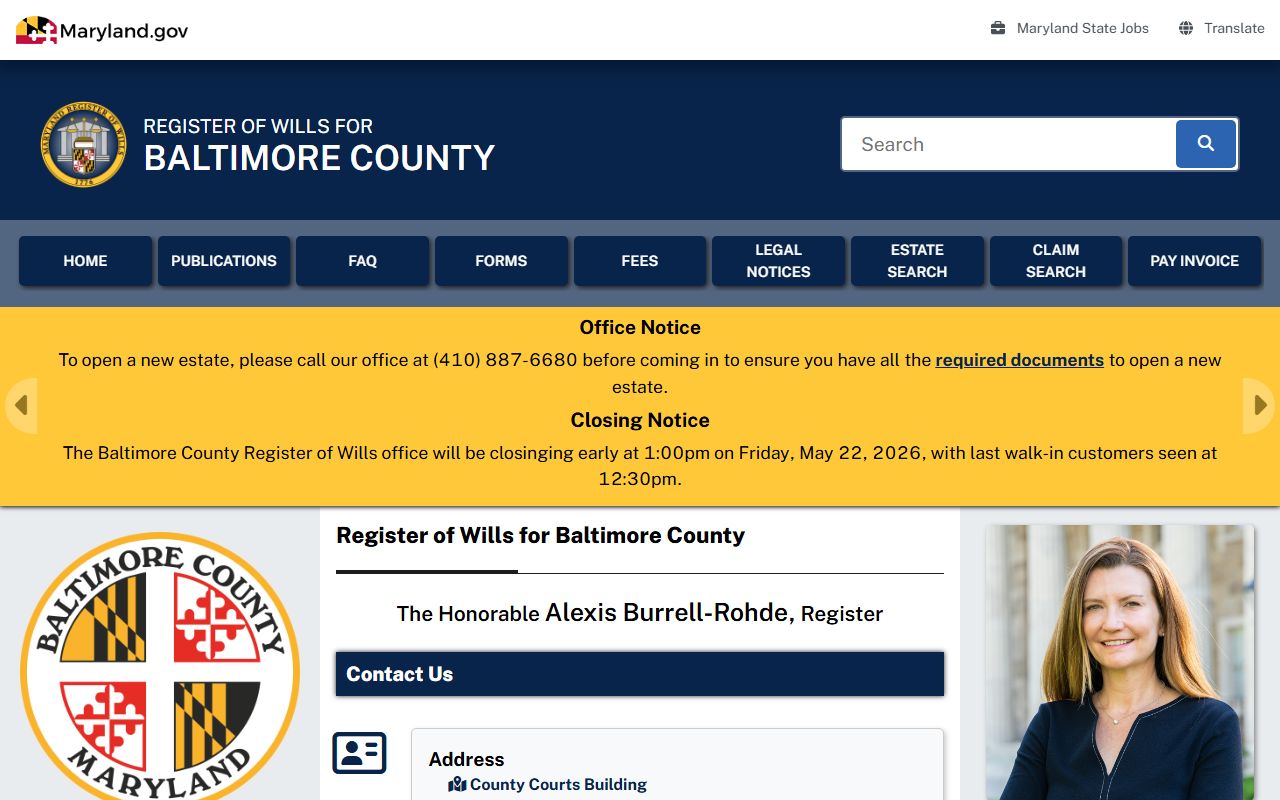
That page links to Estate Search, forms, and fees, so it works well as a single hub for Baltimore County probate needs.
Restricted Baltimore County Probate Records
Most estate files are open to the public, but not every part is visible. Sensitive identifiers such as full Social Security numbers and full account numbers do not appear in the ordinary public display. Some guardianship and estate matters tied to minors or to mental health can carry added limits under state law.
If a document you expect is missing from the online view, it may be held at the office or restricted. The Register can tell you what is available and how to request a copy. Certified copies of estate documents come from the Register, not from the online search.