
Maryland Public Information Act
The Maryland Public Information Act is the state's open records law. It lives in the General Provisions Article, Title 4. The law gives the public a broad right to see and copy records held by state and county agencies. It applies to Baltimore County offices, boards, and departments. The starting rule is simple. Records are open unless a law, rule, privilege, or court order keeps them closed. The Act covers more than paper. It reaches emails, databases, photos, maps, and other formats kept by an agency. The Maryland Attorney General runs an open government program and offers guidance on how the Act works.
The Attorney General's open government portal explains the Act in plain terms and links to forms and contacts, and you can reach it through the Maryland Attorney General OpenGov page.
That portal is the best first stop when a Baltimore County public records request is not court related. It points requesters to the right office and sets expectations on timing and cost.
Anyone may file a request. You do not have to be a Maryland resident, and you usually do not need to give a reason. A "person in interest" gets extra rights to their own records. The Act defines who keeps a record and who may ask for it. For a deeper read, the Attorney General publishes a full manual that walks through the law section by section. The manual covers definitions, the right to inspect, fees, timing, and denials, and it is available as the Maryland PIA Manual PDF.
The manual is a practical tool for both requesters and county custodians. It is the source many Baltimore County agencies follow when they answer a request.
Key Maryland PIA Statutes
- Md. Code, General Provisions § 4-101
- Defines the core terms, including applicant, custodian, public record, and person in interest.
- Md. Code, General Provisions § 4-201
- Grants the general right to inspect and copy public records unless an exception applies.
- Md. Code, General Provisions § 4-203
- Sets how fast an agency must grant or deny a request and how long it can take.
- Md. Code, General Provisions § 4-206
- Controls fees for search, preparation, and copying, and allows fee waivers in some cases.
- Md. Code, General Provisions § 4-301
- Requires denial when releasing a record would break another law.
- Md. Code, General Provisions § 4-330
- Limits release of certain personal records and supports privacy redactions.
Each section above does one job. The definitions section is where the law spells out who counts as a custodian and what a public record is, and you can read the term list at Md. Code, General Provisions § 4-101.
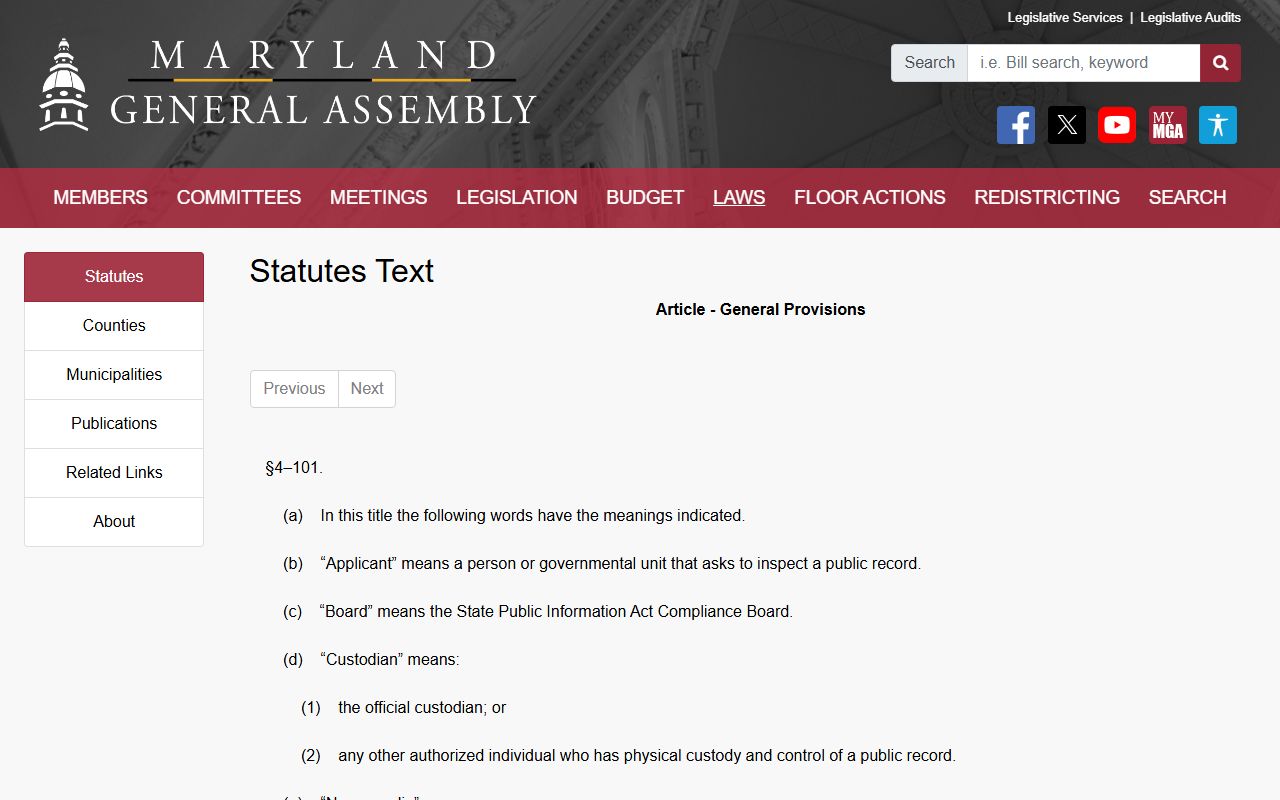
Those defined terms drive the rest of the Act. Read together, the sections above form the backbone of every Baltimore County public records request that goes to a county agency rather than a court.
Court Records vs Agency Records
Maryland splits public records into two tracks, and the split matters. Court records are the case files of the Circuit Court for Baltimore County and the District Court locations in Towson, Catonsville, and Essex. They follow the Maryland Rules and Judiciary policy, not the open records law. You search them through the Maryland Judiciary Case Search portal, and you ask the Clerk for certified copies or sealed files. Agency records are everything a county office keeps that is not a court file. Those fall under the Public Information Act.
The same fact can sit in both tracks. A record may be a public agency record yet still be withheld if a statute, rule, privilege, or sealing order applies. That is why a request for a court file goes to the Clerk while a request for a county department's emails or reports goes through the open records law. Pick the wrong track and the office may send you elsewhere, which costs time.
For agency records, the open records law gives a broad right to inspect, and that right is set out in Md. Code, General Provisions § 4-201.
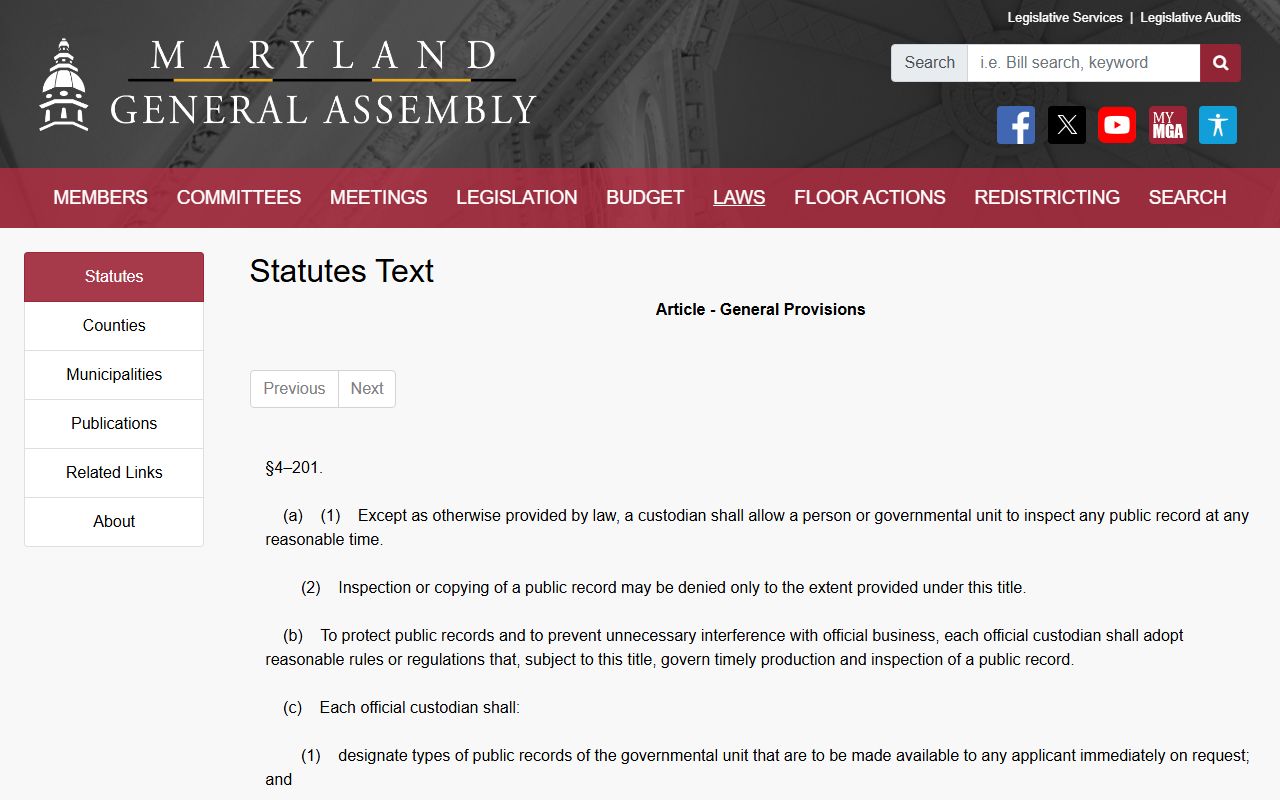
That right is the legal basis for most agency requests in the county. Note: Baltimore County is separate from Baltimore City, so confirm the right jurisdiction before you file a Baltimore County public records request.
Baltimore County Records Beyond the Courts
The county and the Clerk of the Circuit Court keep many record types open to the public. Some are searched online. Some need a written request or a counter visit. Land records are recorded through the Clerk, and they include deeds, mortgages, liens, and judgments tied to property. The Clerk also issues marriage licenses and keeps marriage records for licenses issued in Baltimore County. Probate files sit with the Register of Wills and the Orphans' Court, not the Circuit Court counter. Vital certificates may run through the Maryland Department of Health depending on the record.
- Land records: deeds, mortgages, liens, and money judgments recorded through the Clerk.
- Marriage records: licenses issued by the Clerk of the Circuit Court.
- Business and financing filings indexed in the land and judgment systems.
- Estate and probate files held by the Register of Wills and Orphans' Court.
- County agency records: reports, contracts, permits, and emails under the open records law.
For estate files, use the Register's tools rather than the court case portal. Divorce decrees are a Circuit Court case record, while a divorce or marriage certificate may involve the state health department. Knowing which office holds the file tells you where to send the request.
How to File a Public Records Request
A Baltimore County public records request works best in writing. Address it to the office that holds the record, called the custodian. Be clear and specific about what you want. A narrow request moves faster and costs less. You can send the request by mail, email, or an online form where an office offers one. The Attorney General's open government program can help you find the right contact if you are unsure.
- Find the right office. Court files go to the Clerk of the Circuit Court for Baltimore County. Agency files go to the county department that holds them.
- Describe the records clearly. Name the type, the dates, and any case or file numbers you have. Specific requests get answered faster.
- Put it in writing and submit it by mail, email, or the office's online form. State that you are making a request under the Maryland Public Information Act.
- Wait for the response. The custodian must grant or deny the request within the time limits set by law and may contact you to narrow the scope.
- Pay any allowed fees and receive the records. Ask for a fee estimate first if cost is a concern, and request a waiver if it qualifies.
Before you send a Baltimore County public records request, run through a short checklist. It cuts back-and-forth and helps the custodian act fast.
- Your name and a way to reach you.
- A clear description of the records you want.
- A date range to limit the search.
- Your preferred format, such as paper or electronic.
- A note asking for a cost estimate before work begins.
- A fee waiver request if release serves the public interest.
Public Records Request Form Fields
Most Baltimore County offices accept a plain written request, and some offer a short form. The fields below cover what a custodian needs to act. Give as much as you can. The more detail you provide, the less the office has to guess, and the faster your public records request moves.
| Field | Required | Notes |
|---|---|---|
| Requester Name | Yes | Identifies who is asking; a person in interest may get added rights to their own records. |
| Contact Information | Yes | Mail or email address so the office can reply, send an estimate, or ask questions. |
| Description of Records | Yes | The record type and any case, file, or property numbers you have. |
| Date Range | No | Narrows the search and can lower the fee. |
| Format Preference | No | Paper, electronic, or inspection in person where allowed. |
| Fee Waiver Request | No | State the public interest if you seek a waiver under the fee statute. |
Note: a request that names the office, the record, and a date range usually gets a faster answer than a broad ask for "everything."
Baltimore County Public Records Timelines
The Public Information Act sets the clock on every agency request. A custodian must grant or deny a request promptly and within the statutory limits, and the timing rules live in the law itself. The full text on response duties is set out in Md. Code, General Provisions § 4-203.
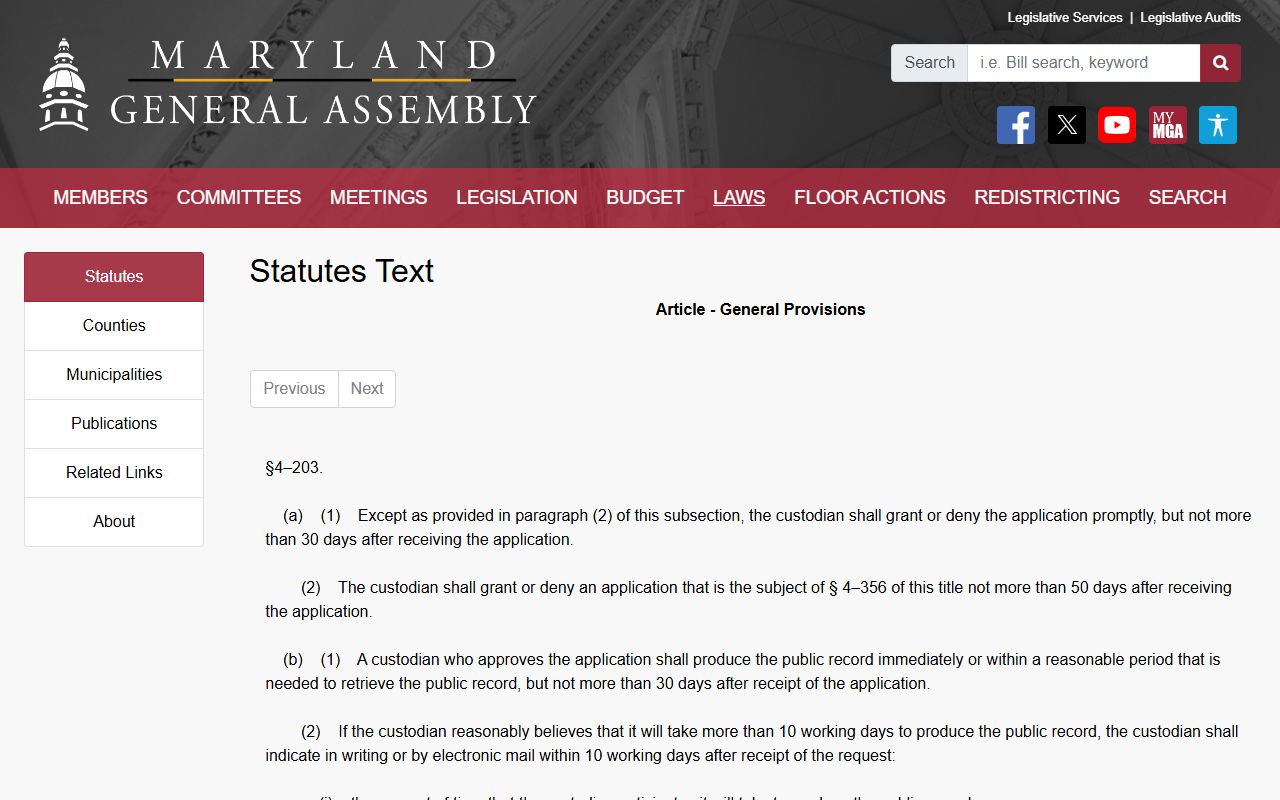
That section is the rule a Baltimore County custodian follows when it decides how fast to act. If the office needs more time, it must tell you and explain why. The table below gives the general flow under the timing and fee statutes. It does not list dollar amounts, since exact county charges depend on the office and the work involved.
| Stage | What Happens | Authority |
|---|---|---|
| Acknowledgment | The custodian receives the request and identifies the records. | § 4-201 |
| Prompt response | The office must grant or deny within the statutory time and may seek a brief extension with notice. | § 4-203 |
| Fee estimate | If costs apply, the office may give an estimate before doing the work. | § 4-206 |
| Production or denial | Records are released, redacted, or denied with a written reason. | § 4-203, § 4-301 |
Baltimore County Public Records Fees
The Public Information Act lets an agency charge for the real cost of a request. Fees must be reasonable and tied to the work. They can cover search time, preparation, and copying. The first part of staff time is often free, and an office may waive fees when release serves the public good. The fee rules are set out in Md. Code, General Provisions § 4-206.
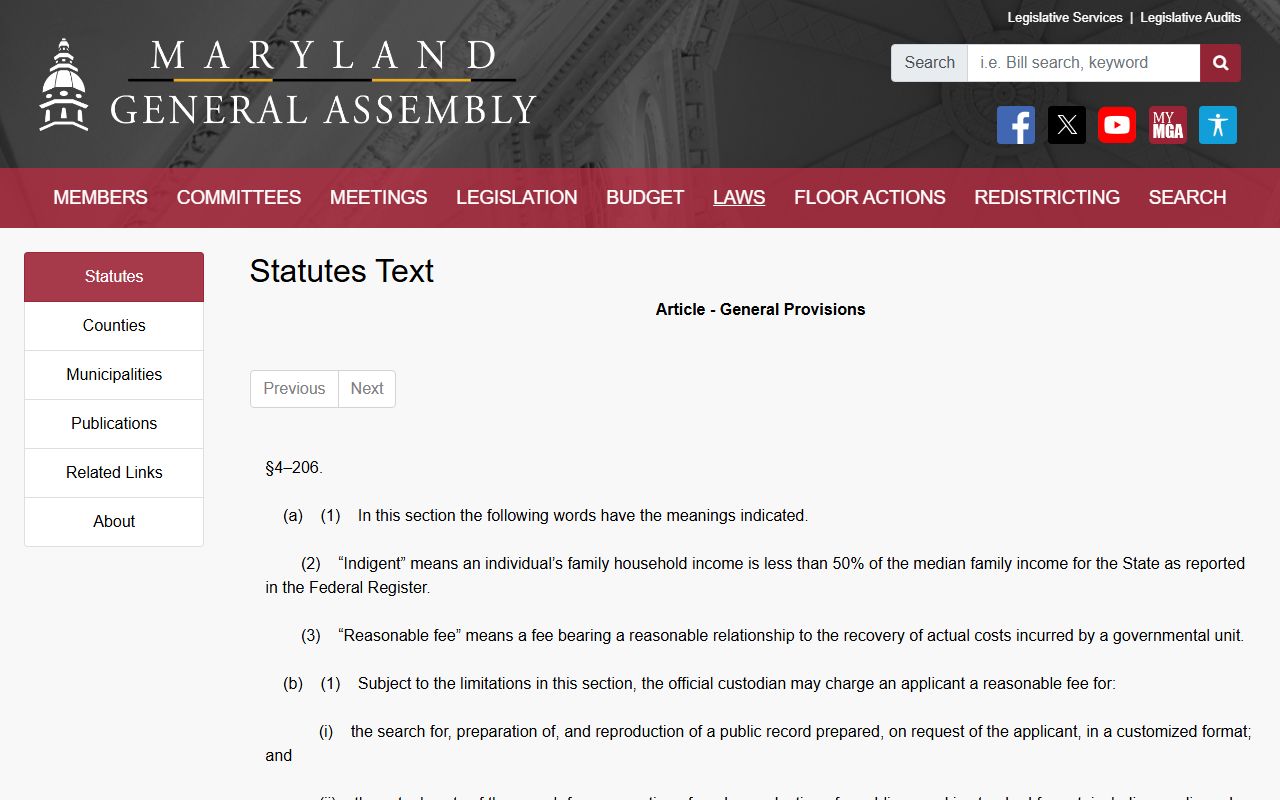
That section is what a Baltimore County office uses to set charges. Exact dollar amounts vary by office and by the size of the request, so ask for an estimate before the work starts. The table below shows the kinds of charges allowed under the fee statute, not set prices.
| Charge Type | Basis |
|---|---|
| Search time | Staff time to locate records, after any free time the law allows. |
| Preparation and review | Time to pull, review, and redact records before release. |
| Copies | Per page or per item, tied to the format requested. |
| Fee waiver | May be granted when disclosure is in the public interest. |
Court copy fees are different and are set by the Clerk of the Circuit Court rather than the open records law. Probate copy fees are published by the Register of Wills. Ask the right office for its current schedule before you assume a cost.
Confidential Baltimore County Records
Open access has limits. Some records stay closed no matter who asks. The Act forces a custodian to deny a request when release would break another law, and that mandatory denial rule is found in Md. Code, General Provisions § 4-301. This is why a Baltimore County public records request cannot pry loose juvenile, adoption, or medical files. Personal privacy gets its own protection under Md. Code, General Provisions § 4-330, which limits release of certain personal records.
Court rules add another layer for case files. Several categories are restricted by statute or rule:
- Juvenile delinquency and CINA records.
- Adoption records, which are confidential by law.
- Mental health and civil commitment records.
- Sealed civil or family files closed by court order.
- Grand jury materials and child welfare files.
Even an open record may come with parts blacked out. Redactions protect items like Social Security numbers, bank account numbers, victim and minor identifiers, medical data, and addresses shielded by court order. The office removes those parts and releases the rest.
Criminal History Record Limits
Criminal history is not a routine public record in Maryland. The state controls who can get a person's criminal history through a separate law, and dissemination rules are set out in Md. Code, Criminal Justice Information § 10-616. A general open records request will not produce a full rap sheet. Public case data is searchable through Maryland Judiciary Case Search, but compiled criminal-history files are limited to authorized users and purposes.
Two more processes pull records out of public view. Expungement removes eligible criminal records from public access, and shielding limits public access to certain conviction records while keeping them for law enforcement. Expunged or shielded matters will not show up as normal results in a Baltimore County public records search.
Note: an expunged or shielded record may still be reachable by certain agencies, so removal from public search does not always mean total erasure.
Denials and Appeals
A denial is not the end of the road. If a Baltimore County agency turns down a request, it must give a written reason and point to the law it relies on. You have several ways to push back. The Maryland Attorney General's open government program offers mediation and guidance, and a state board can review some disputes. The courts remain an option too. A requester may file a civil action to compel release where the law supports it.
Court-record disputes work differently. If the Clerk of the Circuit Court denies access to a sealed or restricted file, the route is usually a motion to the court rather than the open records appeal process. The judge decides under the Maryland Rules. Knowing which track your request sat on tells you which appeal path to take.
Note: keep copies of your request and the denial, since dates and the stated reason matter if you escalate the dispute.