
How to Search Baltimore County Court Records
The main tool is Maryland Judiciary Case Search. It is the free, statewide public portal for many District Court and Circuit Court cases. You can search by a person or business name, or by a case number. The portal covers civil, criminal, traffic, landlord-tenant, and family case entries for the Circuit Court for Baltimore County and the local District Court. It is a public index and docket system. It does not promise that every document image is online. For certified copies, sealed files, or older archived files, you contact the clerk.
Before you start, gather a few things. Have the full legal name of a party, or the exact case number from a court notice. A case number is more reliable than a name, since common surnames return many rows. Pick the right court too. Use the District Court for traffic, small claims, landlord-tenant, peace and protective orders, and most misdemeanors. Use the Circuit Court for divorce, felony, major civil, family, and jury cases. One key warning: Baltimore County is not the same as Baltimore City. They are separate filters in Case Search, so set the county correctly.
- Open Maryland Judiciary Case Search and read the Case Search FAQ if you have questions about what shows.
- Accept the terms and disclaimer screen. You may also see a browser or security check.
- Choose your search method. Most users pick person or business name, but a case number is faster when you have one.
- Enter at least the required name or case number. For a name search, the last name is required.
- Narrow the results. Set the court system to Circuit or District, set the county to Baltimore County, and add a case type or date range if those filters appear.
- Run the search and read each result row for case number, court, filing date, party names, case type, and status.
- Open a case detail page to view docket entries, hearing dates, charges, and disposition.
- Contact the Clerk of the Circuit Court for certified copies, the full file, or any record not shown online.
Baltimore County Court Records Search Fields
The Case Search form changes its exact labels over time, but the core fields stay the same. The table below lists the public search fields and what each one does. Some fields are required only for a certain search type. A last name is needed for a person search. A case number is used for a direct lookup. The county and court system dropdowns help you keep results inside Baltimore County and away from Baltimore City or other jurisdictions.
| Field Label | Type | Required | Notes / Format |
|---|---|---|---|
| Search For / Search Type | Tab / Dropdown | Yes | Person name, business name, or case number; exact labels vary by interface. |
| Last Name | Text | Conditional | Required for a person-name search; spelling matters, use fewer terms to broaden. |
| First Name | Text | No | Narrows a person-name search. |
| Middle Name / Initial | Text | No | Narrows a person-name search where available. |
| Company / Business Name | Text | Conditional | Used for a business-party search. |
| Case Number | Text | Conditional | Direct case lookup; enter the full number as shown on notices. |
| Court System | Dropdown | No | Circuit Court, District Court, or appellate where available. |
| County | Dropdown | No | Select Baltimore County to localize results. |
| Case Type | Dropdown | No | Civil, criminal, traffic, family, and other categories. |
| Filing Date / Date Range | Date | No | Limits older or common-name searches. |
| Party Type | Dropdown | No | Defendant, plaintiff, petitioner, or respondent, if exposed. |
| Search | Button | Yes | Runs the search. |
Note: Expunged and shielded criminal cases do not appear as normal public rows in Case Search, so a clean result does not always mean a clean record.
Types of Baltimore County Court Records
Court records in the county fall into a few broad groups. The case type and any sealing order set how much is public. Civil records cover complaints, answers, motions, orders, judgments, liens, garnishments, and appeals. In the District Court, civil records also include landlord-tenant, small claims, debt collection, and peace or protective orders. Criminal records run from felony indictments and sentencing in the Circuit Court down to misdemeanors, bail reviews, and charging papers in the District Court.
Where a record lives depends on the court. The Circuit Court for Baltimore County handles divorce, custody, child support, felony cases, major civil suits, and juvenile matters. The District Court handles traffic, small claims, landlord-tenant, and most misdemeanors. Probate is different. Estate files do not show in Case Search at all. They run through the Register of Wills and the Orphans' Court and use a separate Estate Search tool.
- Civil records: lawsuits, judgments, liens, and small claims.
- Criminal records: felonies, misdemeanors, charges, pleas, and sentencing.
- Family records: divorce, custody, support, and name change.
- Traffic records: citations and court disposition, kept apart from MVA driver history.
- Probate records: wills, estates, and letters of administration through the Register of Wills.
- Juvenile and mental-health records: restricted by law, not open in normal searches.
What Baltimore County Court Records Show
A case result page packs in a lot of fields. Some are header data about the case itself. Some name the parties and their lawyers. Criminal cases add charge and disposition data. The list below shows the common fields and what each one means, based on the public Case Search interface and its FAQ. Note that addresses for parties may be redacted, and document images are not always posted online even when the docket text lists them.
| Field | What It Shows |
|---|---|
| Case Number | The unique court ID; varies by court, year, county, and case type. |
| Court and Location | Circuit Court for Baltimore County or a District Court site in Towson, Catonsville, or Essex. |
| Case Caption | Names the parties, such as plaintiff and defendant or petitioner and respondent. |
| Filing Date | The date the case was opened. |
| Case Type | Civil, criminal, traffic, family, landlord-tenant, or other category. |
| Status | Open, closed, disposed, dismissed, transferred, sealed, or shielded. |
| Parties | Names and roles; party addresses may be redacted or left off. |
| Attorneys | Counsel names and sometimes firm or contact details. |
| Docket Entries | A dated list of filings, hearings, orders, and dispositions. |
| Hearings | Hearing type, date, time, and courtroom where public. |
| Criminal Fields | Charge, statute, plea, disposition, sentence, probation, and warrant entries. |
| Financial Fields | Fines, costs, restitution, judgment amount, and bond. |
Court records use terms that trip up first-time searchers. A short glossary helps you read a docket without guessing. These definitions match standard Maryland court usage.
- Plaintiff
- The party who starts a civil lawsuit.
- Defendant
- The party sued in civil court, or the person charged in a criminal case.
- Disposition
- The outcome of a charge or a case.
- Judgment
- A final, enforceable decision, often for money or possession.
- Bench Warrant
- A warrant a judge issues, often for a failure to appear.
- Letters of Administration
- A Register of Wills document proving authority to act for an estate.
Public Access Laws for Baltimore County Court Records
Maryland splits public records into two tracks. Government agency records fall under the Maryland Public Information Act, found in the General Provisions Article, Title 4. Court records are governed by Maryland Rules, judiciary policy, and case-specific confidentiality statutes. A record can be a public agency record and still be withheld if a statute, court rule, privilege, or sealing order applies. The PIA right to inspect starts with Md. Code, General Provisions § 4-201, which gives a general right to see public records unless an exception applies.
A few other sections shape how a request works. Md. Code, General Provisions § 4-101 defines the key terms, such as custodian and public record. Md. Code, General Provisions § 4-203 sets the timing rules, so an agency must grant or deny a request within set limits. Fees are covered by Md. Code, General Provisions § 4-206, which ties search, prep, and copy charges to authorized fee rules. The Maryland Attorney General also publishes a PIA Manual and open-government guidance that help with denials and appeals.
Court files are a bit different from agency files. Many court records are open for inspection at the clerk's office or through Case Search, but access to judicial records is set by Maryland Rules. The Clerk of the Circuit Court provides certified copies for a fee. For broader open-records help with county agencies, the Maryland Attorney General OpenGov resources explain how to file and what to expect.
Note: A record can be a public agency file under the PIA yet still be sealed or confidential under a court rule, so two laws may apply at once.
Sealed and Confidential Baltimore County Court Records
Not every court file is open. State law and court rules close several categories. Juvenile records, adoption files, expunged criminal records, shielded records, mental-health and commitment files, grand jury material, and sealed civil or family files are all kept from the public. Financial identifiers like Social Security and bank account numbers are redacted. Protected addresses in domestic violence cases are also held back. These records will not show as normal rows in Case Search.
Juvenile records get strong protection in Maryland. The juvenile confidentiality rule appears in Md. Code, Courts and Judicial Proceedings § 7-303, which limits who may see juvenile court records to parties, counsel, agencies, and others a court allows.
The Maryland Judiciary explains juvenile record limits in its court records help materials, which note that juvenile files are not open like adult cases.
This protection is why a juvenile matter rarely surfaces in a routine name search, and why even parties may need a court order to view parts of a file.
Adoption files are also closed. The confidentiality rule sits in Md. Code, Family Law § 5-3B-31, which keeps adoption records confidential except as the law allows.
Because of this rule, a person trying to open an adoption file usually needs statutory authorization or a separate court process, not a standard records request.
The Public Information Act backs up these limits. Under Md. Code, General Provisions § 4-301, a custodian must deny a request when inspection would break another law.
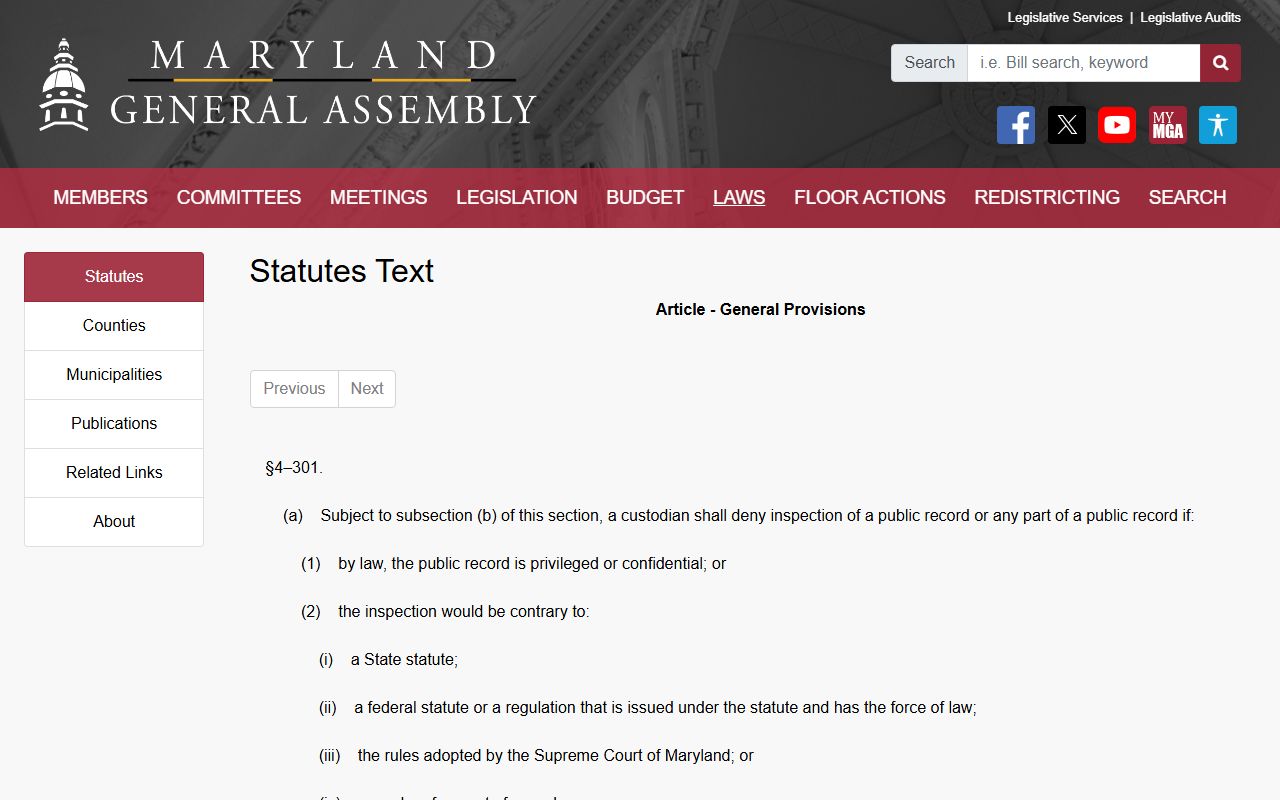
That is the legal hook that stops a PIA request from being used as a side door to confidential juvenile, adoption, or medical court records.
To view a sealed record, you generally file a motion in the court that holds the case and ask a judge to grant access. The court weighs the legal standard and the reason for the request. For help with sealing, expungement, or shielding, the Maryland Judiciary offers court records help and expungement help pages.
Federal Court Records for Baltimore County
Some cases that touch Baltimore County are not in the state courts at all. Federal civil and criminal cases are filed in the U.S. District Court for the District of Maryland, not the county Circuit Court. That court hears federal crimes, civil rights suits, federal-question cases, and more. Its main site is the U.S. District Court for the District of Maryland, and it is the right place to start for any federal matter that involves the county.
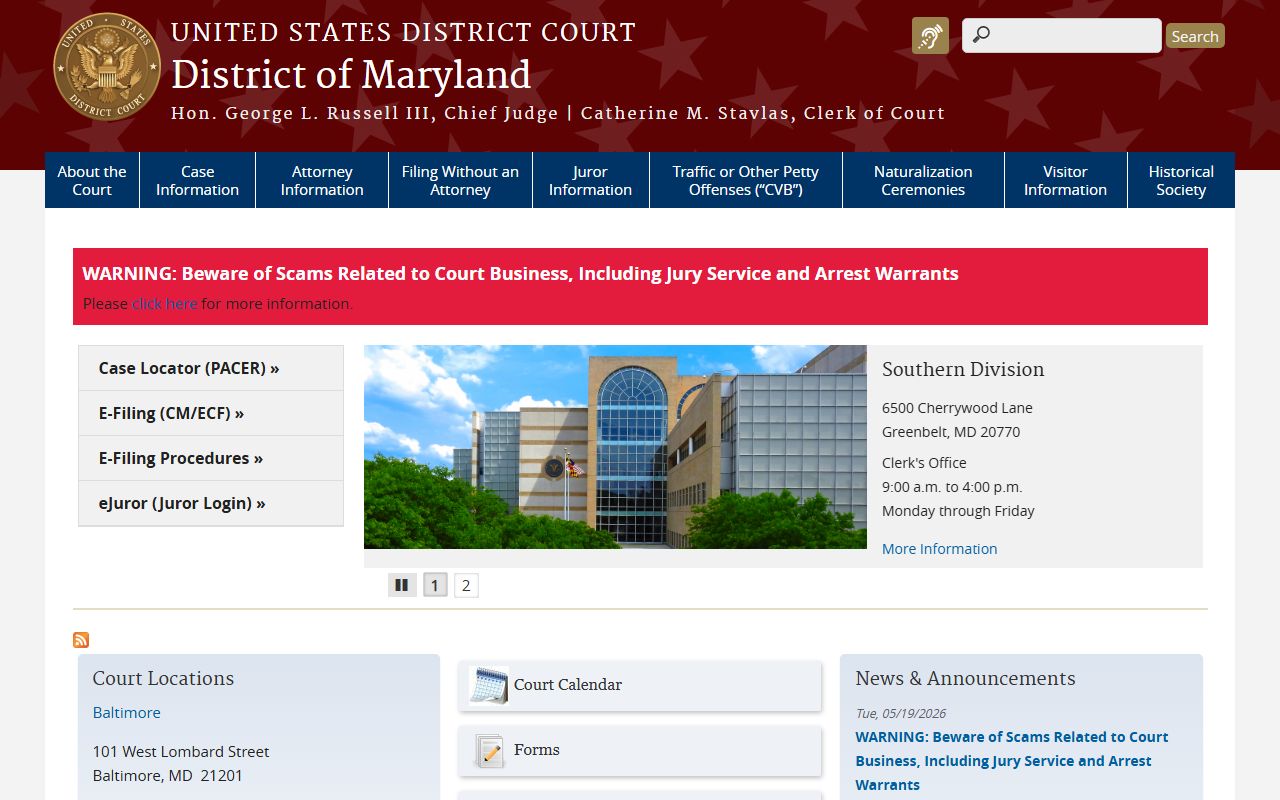
Federal records are not searched the way state cases are. They live in an electronic docket system instead of Case Search.
To pull federal dockets and documents, you use the court's electronic system. The District of Maryland CM/ECF portal connects to PACER, the federal records service that charges per-page access fees and needs an account.
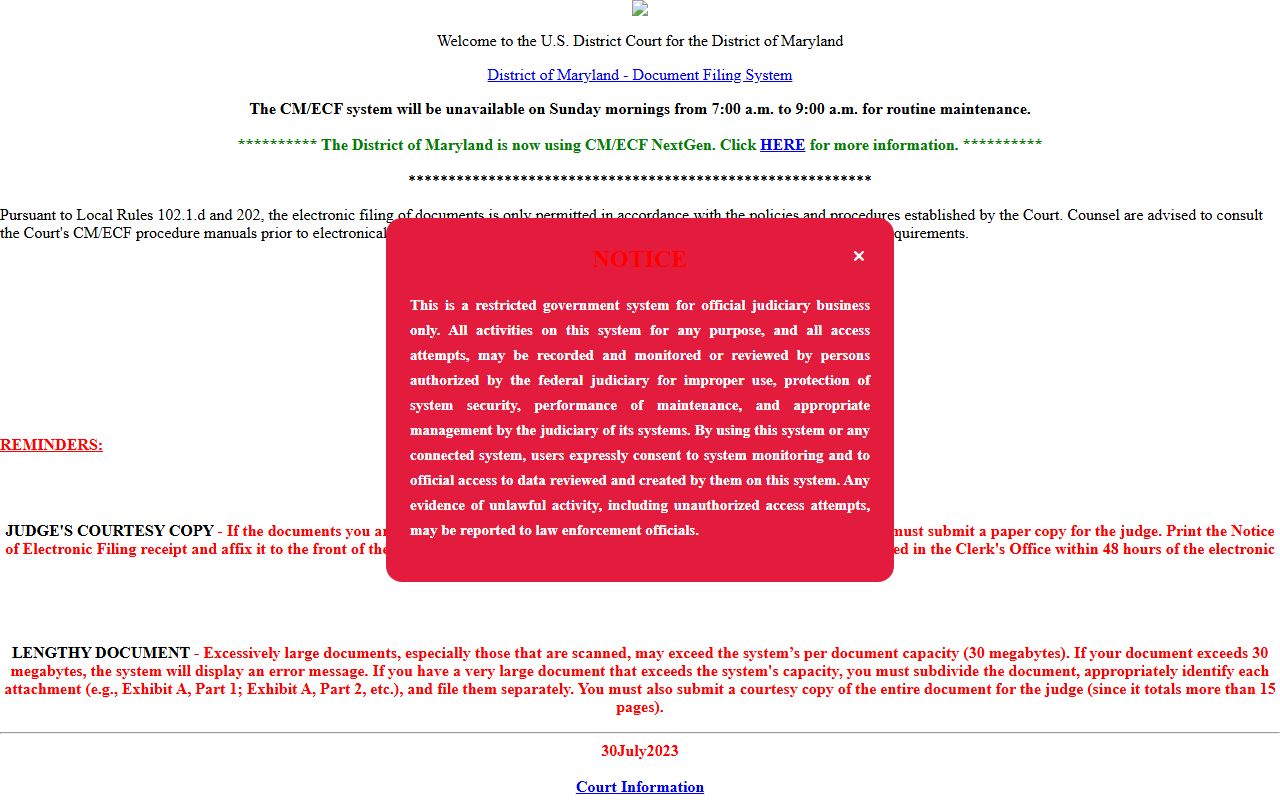
So if a name does not turn up in Case Search but you expect a federal case, CM/ECF and PACER are where to look next.
In-Person Baltimore County Court Record Requests
When a file is not online, you can request it from the clerk. The Clerk of the Circuit Court keeps Circuit Court files, issues certified copies, and helps with marriage licenses and land records. Bring a photo ID, the case number if you have it, and be ready to pay copy fees. Fees are set by the court, so check the official page for the current amounts before you go.
Clerk of the Circuit Court for Baltimore County
County Courts Building
401 Bosley Avenue
Towson, MD 21204
For traffic, small claims, and most misdemeanors, the file may sit at a District Court site instead. The county is served by District Court locations in Towson, Catonsville, and Essex. The full court list is on the Maryland Judiciary Baltimore directory.