How to Search Baltimore County Court Records
The main tool for a Baltimore County court records search is Maryland Judiciary Case Search. It is the free statewide portal for public docket data from both the Circuit Court and the District Court. You can search by a person or business name or by case number. The portal is an index of docket entries, not a full document vault. It will not show every paper in a file, and it will not show records that the law shields, seals, or expunges. For certified copies or sealed-file review, you still go to the clerk.
Before you start, get what you can. A full case number from a notice gives the cleanest result. A correct legal name and a date range help when the surname is common. Pick the right court too. Felony, divorce, and major civil files sit in the Circuit Court, while traffic, small claims, and landlord-tenant matters live in the District Court. The official court-records help page and the Case Search FAQ explain coverage and limits in plain terms.
- Open Maryland Judiciary Case Search and accept the terms and disclaimer.
- Pick a search type, then enter a party name or the full case number.
- Filter by court system, Baltimore County, case type, or a filing date range.
- Review the result rows, then open a case for docket entries, hearings, and disposition.
- Contact the Clerk of the Circuit Court for a certified copy or any file not online.
One routing tip helps most people. Use Case Search for case numbers and dockets, use Estate Search for probate, and use the clerk for certified copies. Probate estates never show up in ordinary Case Search results.
The Baltimore County Judicial System
Baltimore County is part of the Maryland state judiciary, not a separate county-run court. The county provides local buildings and support, while court rules come from the state. The Circuit Court for Baltimore County is the general-jurisdiction trial court. It hears felonies, family law and divorce, major civil cases, juvenile matters, jury trials, and appeals from the District Court and agencies. The District Court of Maryland is a statewide limited-jurisdiction court with local Baltimore County sites. It moves high-volume work: traffic, misdemeanors, small claims, landlord-tenant, and peace or protective orders.
Above the trial courts sit two appeals courts. The Appellate Court of Maryland is the intermediate court, and the Supreme Court of Maryland is the highest court with discretionary review. Probate is its own track. Estates run through the Orphans' Court and the Register of Wills, not the Circuit Court civil counter. The county's Circuit Court department page describes local court services in Towson.
The county Circuit Court department page gives a clear starting point for the local court layout. Use it alongside the state directory to confirm where a case sits before you travel.
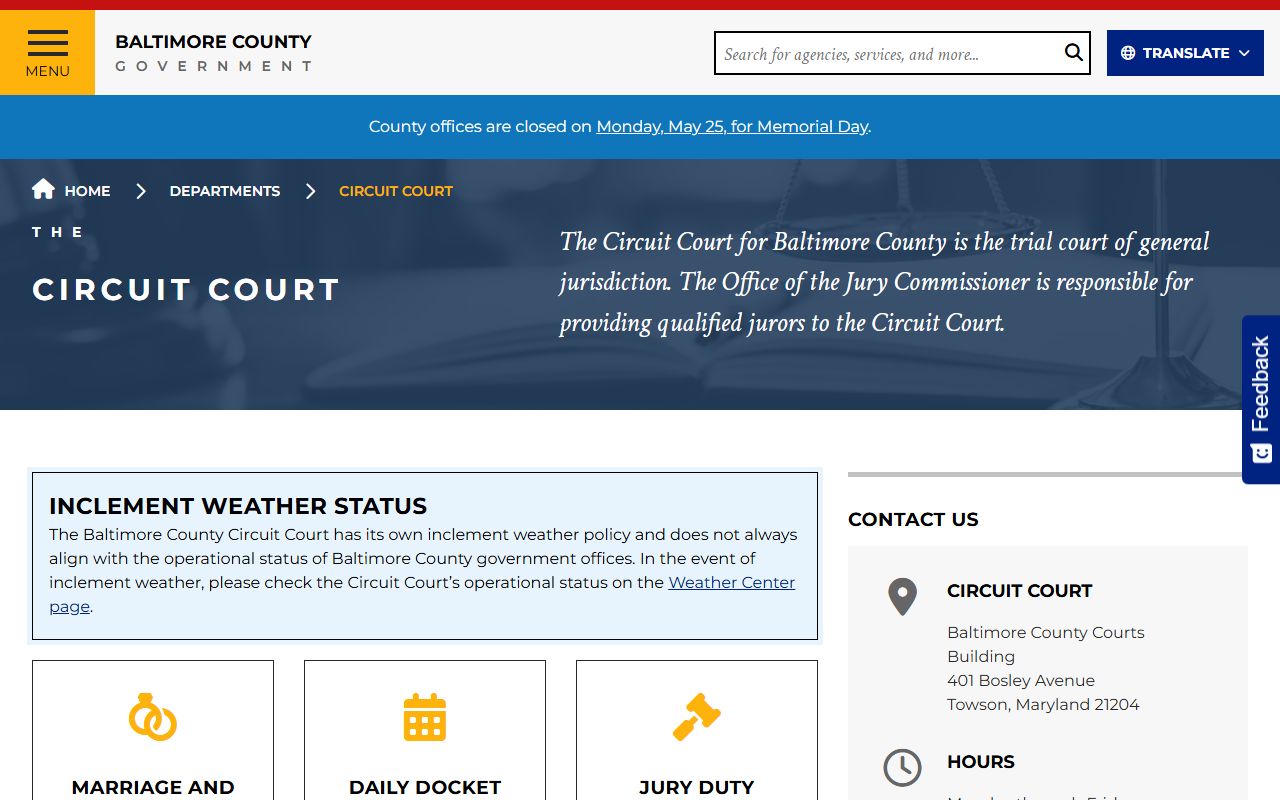
That page links the Clerk, marriage services, and court-copy steps, so it is a useful hub before any Baltimore County court records request.
Case flow: District Court › Circuit Court › Appellate Court of Maryland › Supreme Court of Maryland
| Court | Jurisdiction | Case Types |
|---|---|---|
| Circuit Court for Baltimore County | General trial court | Felony, divorce, family, major civil, juvenile, jury trials, appeals from District Court |
| District Court of Maryland | Limited trial court | Traffic, misdemeanors, small claims, landlord-tenant, peace and protective orders |
| Orphans' Court | Probate court | Wills, estates, personal representatives, estate claims |
| Appellate Court of Maryland | Intermediate appeals | Appeals from Circuit Court and agencies |
| Supreme Court of Maryland | Highest court | Discretionary review, rulemaking |
The split between Circuit Court and District Court trips up many first-time filers. The table below shows the practical difference between the two trial courts.
| Feature | Circuit Court | District Court |
|---|---|---|
| Jurisdiction | General, higher-value and serious matters | Limited, high-volume local matters |
| Common cases | Felony, divorce, major civil, juvenile | Traffic, small claims, landlord-tenant, misdemeanors |
| Jury trials | Yes | No; a jury case can move to Circuit Court |
| Baltimore County sites | Towson | Towson, Catonsville, Essex |
Note: A District Court case with a jury-trial right can be moved to the Circuit Court under Maryland law, so the same dispute may shift courts.
Baltimore County Courthouses
The main court address in Baltimore County is the County Courts Building at 401 Bosley Avenue in Towson. That building holds the Circuit Court, the Clerk of the Circuit Court, jury services, and the Register of Wills for the Orphans' Court. Divorce decrees, felony files, and major civil records all start here. The District Court works from three separate sites, so a traffic or small-claims matter may send you to a different address. Do not assume both courts share one building.
The state Maryland Judiciary directory for Baltimore County lists each court location and its contacts. Check it to confirm the right site before a hearing or a records pickup.
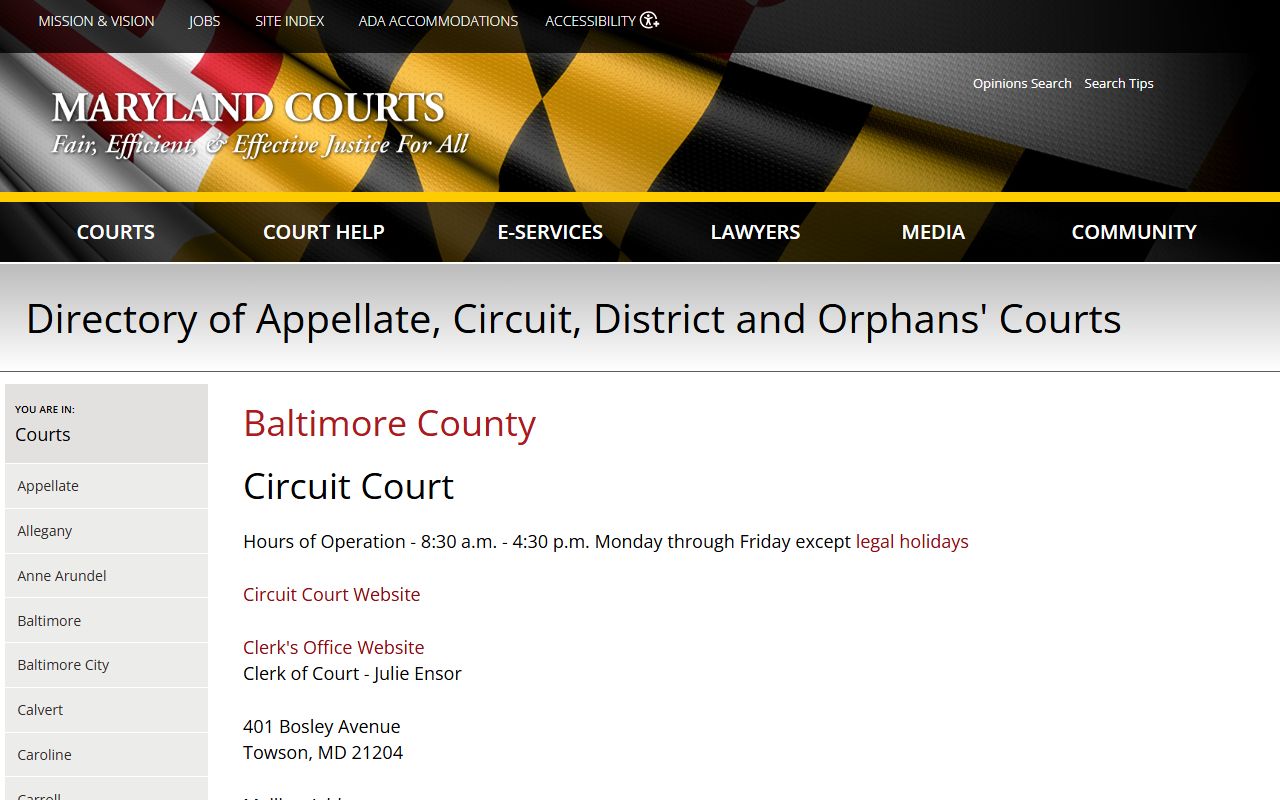
The directory groups the Circuit Court, District Court, and Orphans' Court in one place, which makes routing a Baltimore County court records request much easier.
Circuit Court for Baltimore County
County Courts Building
401 Bosley Avenue
Towson, MD 21204
Important: Baltimore County is a separate jurisdiction from Baltimore City. Records from the city are not county records, and both have separate filters in Case Search and Estate Search.
Types of Court Records Available in Baltimore County
Baltimore County court records cover a wide range. Civil files include complaints, motions, judgments, liens, and garnishments. Criminal files run from misdemeanors in the District Court to felony indictments and sentencing in the Circuit Court. Family records cover divorce, custody, child support, and name change. Probate files sit with the Register of Wills, and traffic cases sit mostly with the District Court. Each court produces its own kind of record, and access depends on case type and any sealing order.
Knowing which court holds a record matters because that is where you request copies. The list below maps the main types to the office that keeps them.
- Criminal records - felony files in the Circuit Court, misdemeanors and charging papers in the District Court.
- Civil records - lawsuits, judgments, small claims, and landlord-tenant cases.
- Family and divorce records - divorce decrees and related family matters in the Circuit Court.
- Probate records - wills, estates, and letters of administration through the Register of Wills.
- Traffic records - citations and payable violations handled by the District Court.
Juvenile, mental-health, and adoption records form a restricted group. They are not part of the ordinary public record set.
What Baltimore County Court Records Show
A Baltimore County court record holds a set of common fields. The case number is the key identifier, and it varies by court, year, and case type. The caption names the parties, such as plaintiff and defendant or petitioner and respondent. Docket entries form a dated list of filings, hearings, orders, and the final outcome. Criminal files add charges, statute references, plea, disposition, and any sentence or probation terms. Some data is redacted, including Social Security numbers, financial account numbers, and protected addresses.
| Field | What It Shows |
|---|---|
| Case Number | The full identifier for the case; use it exactly as printed on notices. |
| Filing Date | The date the case was opened. |
| Parties | Names and roles; some addresses may be redacted or left out. |
| Charges / Cause | The charge and statute in criminal cases, or the claim in civil cases. |
| Disposition | The outcome of a charge or the whole case. |
| Sentence / Judgment | Any sentence, probation, fine, or money judgment. |
The fields you enter to find a record matter just as much as the fields you read. Maryland Judiciary Case Search exposes the search inputs below for public lookups.
| Field | Required | Notes |
|---|---|---|
| Search Type | Yes | Person name, business name, or case number. |
| Last Name | Conditional | Required for a person-name search; spelling matters. |
| First Name | Optional | Narrows a person-name search. |
| Case Number | Conditional | Direct lookup; enter the full number as shown. |
| Court System | Optional | Circuit Court, District Court, or appellate. |
| County | Optional | Pick Baltimore County to localize results. |
| Filing Date Range | Optional | Limits older or common-name searches. |
Public Access Laws for Baltimore County Court Records
Maryland runs two overlapping tracks for public access. Government agency records fall under the Maryland Public Information Act in the General Provisions Article. Court records fall under Maryland Rules, judiciary policy, and case-specific confidentiality statutes. A record can be an agency record yet still be withheld if a statute, privilege, or sealing order applies. Fees must stay reasonable and tied to search, prep, and copying. The Maryland Attorney General publishes a Public Information Act resource hub and a PIA Manual that explain the request process.
Court-record access disputes usually go to the court or clerk and may need a motion or judicial order. The statutes below set the core rules for both tracks.
Key Statutes:
Md. Code, General Provisions § 4-101 - Defines the core PIA terms such as public record, custodian, and person in interest.
Md. Code, General Provisions § 4-201 - Sets the general right to inspect public records unless an exception applies.
Md. Code, General Provisions § 4-206 - Covers fees, including search and prep charges and fee-waiver issues.
Md. Code, General Provisions § 4-301 - Requires denial when release would break the law, which shields confidential files.
Md. Code, Criminal Justice Information § 10-616 - Governs how criminal-history record information may be shared.
Records That Are Restricted or Confidential
Several record types stay out of public view. Juvenile records are limited by Courts and Judicial Proceedings § 7-303, and adoption records are confidential under Family Law § 5-3B-31. Expunged records vanish from public access after a valid order under Criminal Procedure § 10-105, and shielding under Criminal Procedure § 10-110 limits access to certain conviction records. Mental-health, grand jury, and sealed family files also stay closed.
To clear an eligible criminal record, a person files the correct expungement petition in the court that handled the case. Eligibility turns on the disposition, the offense, and any waiting period. The State's Attorney may object. If the court grants the petition, agencies remove the eligible records from public access. The Maryland Judiciary expungement help page hosts the forms and instructions. Shielding works differently because it limits public access without destroying every government copy.
Specialty Courts in Baltimore County
Baltimore County takes part in Maryland problem-solving court models. These programs use judicial supervision, treatment, testing, and case management instead of ordinary case processing. Eligibility is case-specific and usually needs sign-off from the court, the State's Attorney, the defense, and a treatment provider.
The adult drug and treatment court targets people with substance-use disorders tied to criminal or reentry cases. It runs in phases over many months, with frequent status hearings, sanctions, and incentives. Family treatment court serves parents whose substance use affects child welfare or custody, with the goal of safe reunification and stable recovery. Veterans and behavioral-health diversion options may also be available through District Court and Circuit Court partnerships, and current openings should be confirmed with the State's Attorney, the Public Defender, and court administration.
Baltimore County Sheriff and Jail
Baltimore County splits its sheriff and corrections work. The Sheriff's Office serves court process, handles certain warrants, and supports courthouse security. The Department of Corrections runs the county detention system, including inmate information, visitation, mail, and accounts. The main facility is the Baltimore County Detention Center at 720 Bosley Avenue in Towson, near the court complex. No official searchable county jail roster was located, so custody checks run through inmate information, VINELink, and Case Search.
For the full custody workflow, see the Baltimore County inmate records page, and check warrant records for how active warrants are handled. The released inmates page covers release verification across county, state, and federal systems.
Marriage, Divorce, and Orphans' Court
Marriage licenses come from the Baltimore County Clerk of the Circuit Court. Divorce files and decrees are Circuit Court case records, so a certified divorce decree comes from the clerk, not from vital records. For the full process and forms, see the marriage and divorce records page. Estates are different. Probate runs through the Orphans' Court and the Register of Wills, and estate files are searchable through a separate state portal. The Orphans' Court page walks through estate search and filing.
A few probate terms come up often, so they are defined here.
- Testator
- The person who makes a will.
- Personal representative
- The person appointed to administer an estate, sometimes called the executor.
- Intestate
- Dying without a valid will, which sends the estate through state default rules.
- Letters of administration
- The Register of Wills document that proves authority to act for an estate.
Note: Estate Search, not Case Search, is the right tool for probate files, and the two systems do not share results.
Baltimore County Court Records Fees
Fees apply to most Baltimore County court records services. The Clerk of the Circuit Court charges for plain and certified copies, and certified copies usually add a per-page copy charge plus a certification charge. Marriage licenses and land-record recording carry their own fees. Probate fees for the Register of Wills are published on a separate state schedule. Current dollar amounts should be confirmed on the official pages before you pay, since rates can change. The table below points to the right source for each charge.
| Item | Where to Confirm |
|---|---|
| Plain Circuit Court copy | Clerk of the Circuit Court |
| Certified court copy | Clerk of the Circuit Court |
| Marriage license | Clerk of the Circuit Court |
| Probate and estate fees | Register of Wills fee schedule |
How to Interpret Baltimore County Court Records
Reading a docket takes a little care. A charge is not a conviction. The disposition tells you the real outcome, and it may read as guilty, not guilty, dismissed, nolle prosequi, or probation before judgment. A case dismissed with prejudice generally cannot be refiled, while one dismissed without prejudice may come back. A bench warrant or FTA entry means the court flagged a missed appearance. Money cases show a judgment amount and any garnishment or lien. When a docket entry is unclear, the safest move is to confirm the meaning with the clerk before relying on it.
Accuracy and Record Limitations
Online court data is useful, but it is not perfect. Case Search is an index, and some entries lag behind the live file. Older records may not be digitized, so genealogy, land, or estate research can still need clerk or Register help. Expunged and shielded records drop out of public results by law. If you spot an error, contact the office that holds the record rather than the search portal. The clerk handles Circuit Court files, the Register handles estates, and the agency handles its own administrative records.
Note: Confirm any case detail with the originating Baltimore County office before relying on it, because online docket data can lag or omit sealed entries.
History of Baltimore County Courts
Baltimore County is one of Maryland's historic counties, and Towson has long been its county seat. The court system reflects Maryland's old split between county Circuit Courts, statewide District Court sites, and Orphans' Court probate jurisdiction. For generations the Towson courthouse district served as the hub for land recording, probate, criminal justice, and civil disputes. Many older files were never fully digitized, so deep research still leans on the clerk and Register.
The bigger shift was technology. Case Search became the public statewide lookup, MDEC expanded electronic filing, and the Register of Wills added a statewide Estate Search. These tools cut the need to visit Towson for basic case identification, but they did not replace the clerk's power to certify a record.
Legal Help in Baltimore County
Several free and low-cost resources serve people without a lawyer. The Maryland Judiciary self-help page covers court records, expungement, family law, landlord-tenant, small claims, and protective orders. Court Help Centers explain forms and procedures, but staff do not act as attorneys. For criminal cases, financially eligible defendants apply with the Maryland Office of the Public Defender. Protective-order help has its own guidance page.
Common self-help groups include Maryland Legal Aid, the Maryland Volunteer Lawyers Service, and the Women's Law Center of Maryland. Fee waivers are available for eligible filers, but the waiver form must be filed and approved. A frequent mistake is filing in the wrong court, so confirm jurisdiction first.
Frequently Asked Questions
The most common Baltimore County court records questions are answered below.
How do I search Baltimore County court records online?
Use Maryland Judiciary Case Search. Accept the disclaimer, search by name or case number, and filter to Baltimore County when you can. A case number from a notice gives the cleanest result because common-name searches return many unrelated people. Case Search covers many Circuit Court and District Court entries.
Is Case Search the same as the clerk's full file?
No. Case Search is a public docket index. It may show case number, parties, charges, dates, and disposition, but full documents and certified copies usually come from the Clerk of the Circuit Court. The court records page covers the difference.
Which court handles traffic tickets?
The District Court handles most traffic citations in Maryland. Baltimore County has District Court sites in Towson, Catonsville, and Essex. Driver records from the MVA are separate from court traffic records, as the traffic court records page explains.
More on the Baltimore County Court Records FAQ page.