
Baltimore County Circuit Court Overview
The Circuit Court for Baltimore County is the trial court for serious and higher-value cases. It hears felony criminal prosecutions, family law cases like divorce and custody, major civil suits, juvenile matters, and appeals that come up from the District Court and from state agencies. It is the court that holds jury trials. The main courthouse is the County Courts Building at 401 Bosley Avenue in Towson, the county seat. That building also houses the Clerk of the Circuit Court, jury services, and the public access points for Circuit Court files.
Baltimore County is part of the statewide Maryland Judiciary, not a separate county-run court. The County provides local facilities and support, while court rules and public-access policy come from the state. The county department page for the Circuit Court and the Maryland Judiciary Baltimore directory both confirm Towson as the local Circuit Court location. One thing trips up many searchers. Baltimore County is separate from Baltimore City. They are two different jurisdictions with two different Circuit Courts, and they appear as separate filters in Maryland Judiciary Case Search.
Maryland Court System and Hierarchy
Maryland courts run on five main levels. At the top sits the Supreme Court of Maryland, the state's highest court, which takes cases by discretionary review and sets court rules. Below it is the Appellate Court of Maryland, the intermediate appeals court that hears most appeals from the Circuit Courts. The Circuit Court is the general trial court. Under it, the District Court of Maryland handles high-volume, limited matters. The Orphans' Court runs probate for estates and wills.
Each level has a clear job. The trial courts find facts and decide cases. The two appellate courts review legal questions from the trial courts. The Circuit Court for Baltimore County feeds appeals up to the Appellate Court of Maryland, and from there a party may ask the Supreme Court of Maryland to take the case. The District Court and the Orphans' Court are not below the Circuit Court in a strict chain, but the Circuit Court hears certain appeals from the District Court and works alongside the probate system. The full court list for the county appears on the Maryland Judiciary directory.
Baltimore County Court Offices and Addresses
The county is served by the Circuit Court and its Clerk in Towson, three District Court locations, and the Register of Wills for estate matters. The table below lists each court or office with its address and what it handles. The District Court has three sites because it carries the largest case volume in the county.
| Court / Office | Address | Jurisdiction |
|---|---|---|
| Circuit Court for Baltimore County | 401 Bosley Avenue, Towson, MD 21204 | General civil, felony criminal, family, juvenile, jury trials, appeals from District Court and agencies |
| Clerk of the Circuit Court | 401 Bosley Avenue, Towson, MD 21204 | Circuit Court files, plain and certified copies, marriage licenses, land records services |
| District Court – Towson | 120 East Chesapeake Avenue, Towson, MD 21286 | Traffic, misdemeanors, preliminary hearings, landlord-tenant, small claims, protective and peace orders |
| District Court – Catonsville | 900 Walker Avenue, Catonsville, MD 21228 | District Court cases for the Catonsville area |
| District Court – Essex | 8914 Kelso Drive, Essex, MD 21221 | District Court cases for the Essex and east county area |
| Orphans' Court / Register of Wills | 401 Bosley Avenue, Towson, MD 21204 | Probate estates, wills, personal representatives, estate claims |
The Clerk shares the County Courts Building address with the Circuit Court. For a felony file, a divorce decree, or a major civil judgment, you start at 401 Bosley Avenue or at the case search portal. For traffic, small claims, or a peace order, you may need one of the three District Court sites instead. Confirm hours and current contact details on the official directory pages before you travel.
What the Baltimore County Circuit Court Handles
The Circuit Court takes the cases that carry the most weight. On the criminal side, it hears felony prosecutions and serious offenses, from indictment or information through arraignment, pretrial, trial, and sentencing. The State's Attorney for Baltimore County brings these cases. Maryland uses the term "State's Attorney" rather than District Attorney. People who cannot afford a lawyer may get one through the Maryland Office of the Public Defender.
On the civil side, the Circuit Court handles major money cases, property disputes, equity matters, and cases above the District Court's limits. Family law is a large part of the docket. Divorce, custody, child support, and domestic violence cases are Circuit Court matters. Juvenile cases, such as delinquency and child-in-need-of-assistance matters, are also handled here, though those records are restricted by statute. The court hears appeals from the District Court and from certain state agency decisions. And it is the court where you get a jury trial. The State's Attorney's Office page and the county Circuit Court page describe these case types in more detail.
Note: Probate is not a Circuit Court division in Maryland; estates run through the Register of Wills and the Orphans' Court instead.
Circuit Court vs District Court
The two trial courts split the workload by the size and type of the case. The Circuit Court is built for serious, higher-value, and jury matters. The District Court is built for fast, high-volume, lower-stakes matters. The comparison below shows how they differ across the most common points people ask about.
| Circuit Court | District Court | |
|---|---|---|
| Case stakes | Major civil, felonies, family, juvenile | Traffic, misdemeanors, small claims, landlord-tenant |
| Jury trials | Yes | No |
| Family law | Yes, including divorce and custody | Limited; peace and protective orders |
| Felony cases | Full felony trials and sentencing | Charging and preliminary hearings only |
| Locations in county | One, in Towson | Three: Towson, Catonsville, Essex |
District Court does not hold jury trials. When a party has the right to a jury and wants one, Maryland law lets the case move up to the Circuit Court. That is one way a matter shifts from the limited court to the general court. Both courts post docket information through Maryland Judiciary Case Search, but the filings and courtroom events stay with the clerk office for the court that holds the case.
Civil, Family, and Criminal Divisions
The Circuit Court for Baltimore County organizes its work into divisions so that judges and staff focus on related case types. The civil division hears money disputes, property cases, contract claims, equity matters, and appeals from limited-jurisdiction cases. Civil records here include complaints, answers, motions, orders, judgments, liens, and garnishments. The court records page covers how to read these files.
The family division handles divorce, custody, child support, name changes, and domestic violence cases. Many family dockets are public, but filings that involve minors, financial details, medical information, or sealed orders may be restricted. Adoption records are confidential by Maryland statute. The criminal division handles felony indictments and informations, arraignments, pleas, trials, sentencing, probation orders, and post-conviction matters. Expunged and shielded records do not appear in ordinary public searches. Each division files through the Clerk of the Circuit Court at the Towson courthouse.
How a Case Moves Through the System
Cases generally start at the trial level and can climb to the appellate courts. A matter that begins in the District Court can reach the Circuit Court, and a Circuit Court case can be appealed up the state ladder. The simple path runs like this.
Appeal path: District Court › Circuit Court › Appellate Court of Maryland › Supreme Court of Maryland
The two trial-court tracks move through their own stages before any appeal. The criminal track and the civil track look like this.
Criminal flow: Arrest › First Appearance › Indictment or Information › Arraignment › Pretrial › Trial › Sentencing › Appeal
Civil flow: Complaint Filed › Answer › Discovery › Motions › Trial › Judgment › Appeal
A District Court case with a jury-trial right can be moved to the Circuit Court before trial. From the Circuit Court, most appeals go to the Appellate Court of Maryland. The Supreme Court of Maryland then takes only the cases it chooses to review. Estate matters follow a separate path through the Orphans' Court, which you can read about on the Orphans' Court page.
District Court Locations in Baltimore County
The District Court of Maryland is the limited-jurisdiction court that handles most of the county's everyday cases. It runs three sites so it can cover the whole county. The Towson site is close to the Circuit Court but is a separate building. The Catonsville site serves the west side, and the Essex site serves the east side. District Court handles traffic citations, many misdemeanors, landlord-tenant disputes, small claims, and peace and protective orders. It also holds preliminary hearings in felony cases before those cases move to the Circuit Court.
Each site keeps its own counter and clerk staff, even though all District Court case data flows into the same statewide search system. To find a specific District Court location's hours and services, check the official directory page for that site.
The Essex District Court directory page shows the office that serves the east county area.
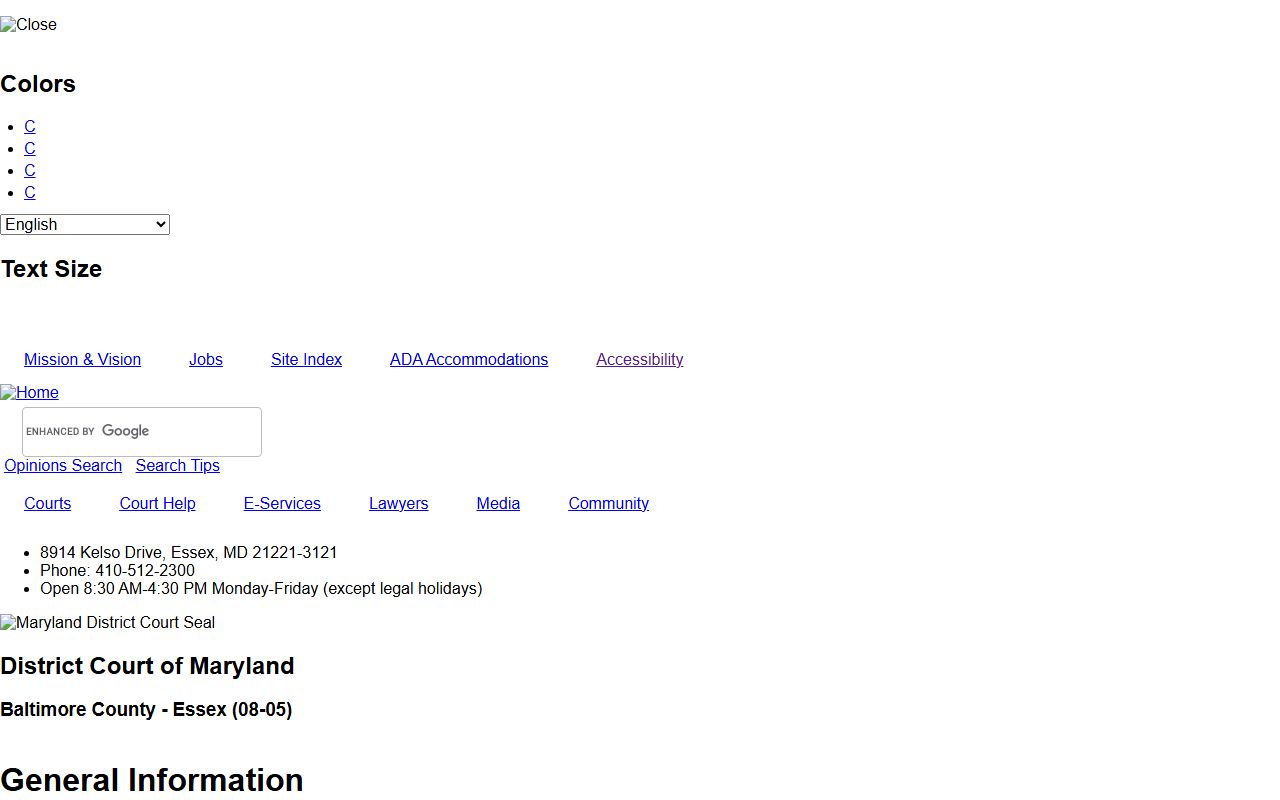
The listing at the District Court Essex directory gives the address and the case types handled there. Towson and Catonsville have their own directory pages with the same kind of detail.
Orphans' Court and Probate Matters
Probate sits outside the Circuit Court in Maryland. The Orphans' Court and the Register of Wills handle estates, wills, personal representatives, and estate claims. The Register receives the filings, maintains the estate records, and issues letters of administration. The Orphans' Court decides contested probate questions. Both share the County Courts Building address in Towson.
Estate files are searchable through the Register of Wills' statewide Estate Search, which is a different system from the court case search. More complex estate disputes can reach the Circuit Court, but routine estate work stays with the Register and the Orphans' Court. The Orphans' Court page covers how to search estate records and what fees apply.
Federal Courts Serving Baltimore County
Some cases never touch the county courts at all. Federal civil and criminal cases for Baltimore County are filed in the U.S. District Court for the District of Maryland, not in the Circuit Court. The federal court hears federal criminal prosecutions, civil rights cases, federal-question civil suits, and other matters under federal law. Records are available through PACER and CM/ECF, which charge per-page access fees.
Bankruptcy is its own federal court. The U.S. Bankruptcy Court for the District of Maryland handles bankruptcy filings for people and businesses in the county, again through PACER. Appeals from the federal district court go to the U.S. Court of Appeals for the Fourth Circuit in Richmond.
The Fourth Circuit hears federal appeals from Maryland and several nearby states.
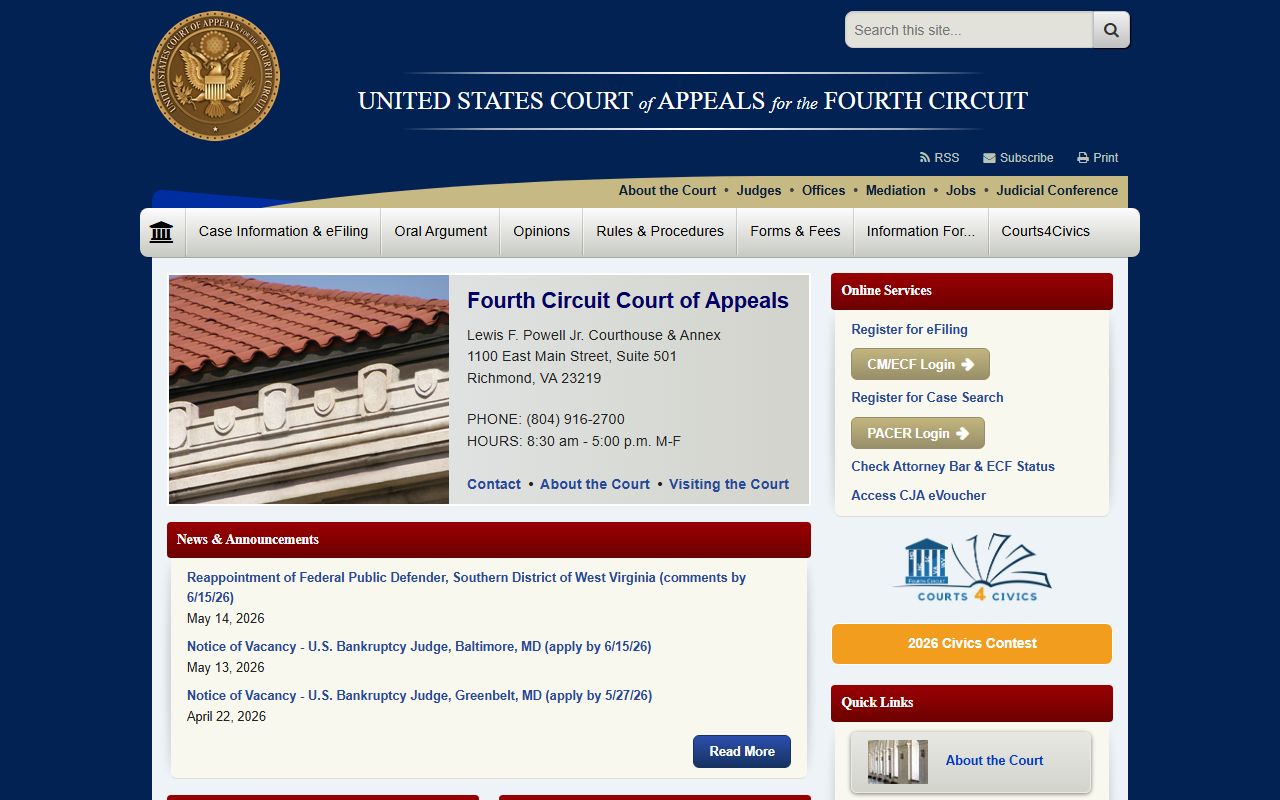
You can read about its role and find opinions on the Fourth Circuit site. The U.S. District Court for the District of Maryland feeds appeals to this court.
Bankruptcy filings go to a separate federal court for the state.
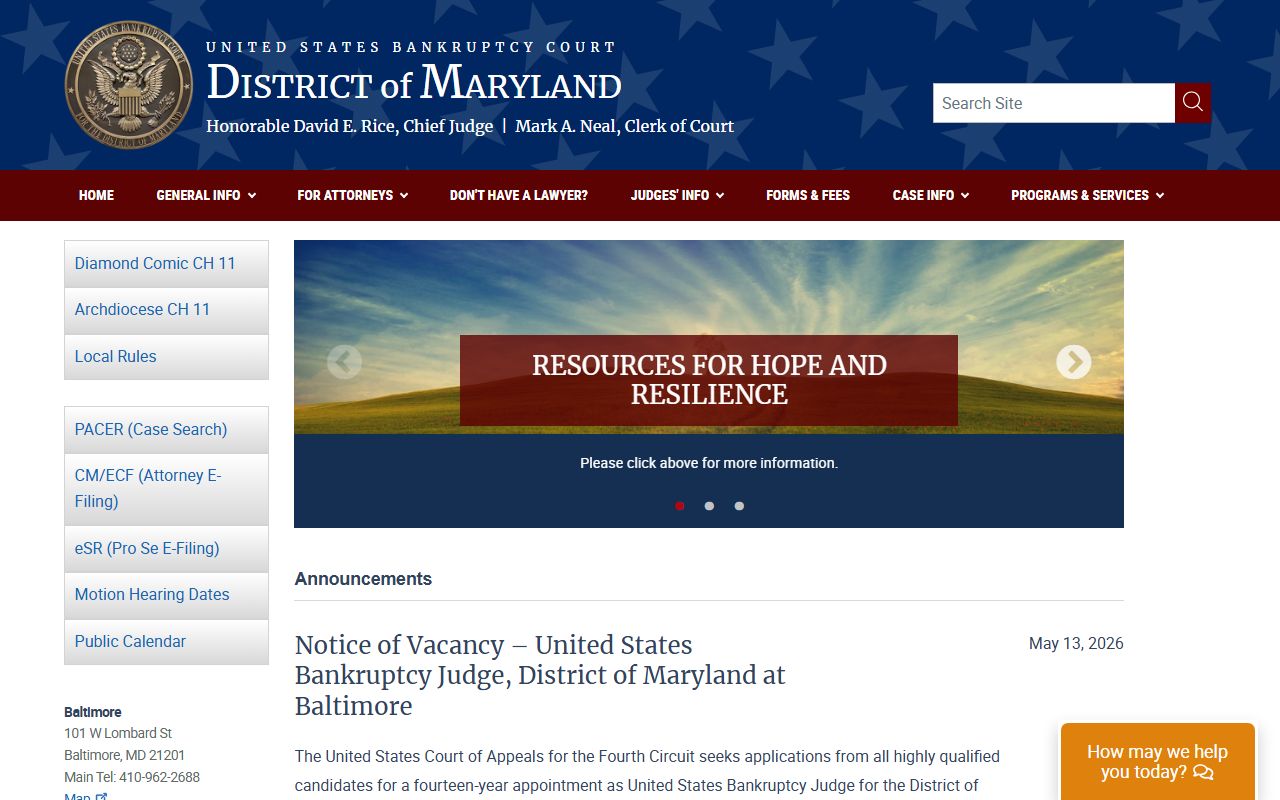
The U.S. Bankruptcy Court for the District of Maryland page explains how to file and how to search bankruptcy records. The main U.S. District Court site links to PACER and the local CM/ECF system.
Common Court Terms
Court files use words that may be new to many people. The short list below explains a few terms that show up often in Baltimore County Circuit Court records.
- Plaintiff
- The person or business that starts a civil case by filing a complaint.
- Defendant
- The person or business that the case is brought against, in a civil or criminal matter.
- Indictment
- A formal charge in a felony case, often issued by a grand jury, that moves the case to the Circuit Court.
- Disposition
- The final result of a case, such as a verdict, a guilty plea, or a dismissal.
- Docket
- The running list of filings and events in a case, viewable through the state case search.
Note: Sealed, shielded, and expunged records are removed from ordinary public searches, so they will not appear in standard case search results.